
Beyond the Sky: Why I Started This Journey
Who I Am
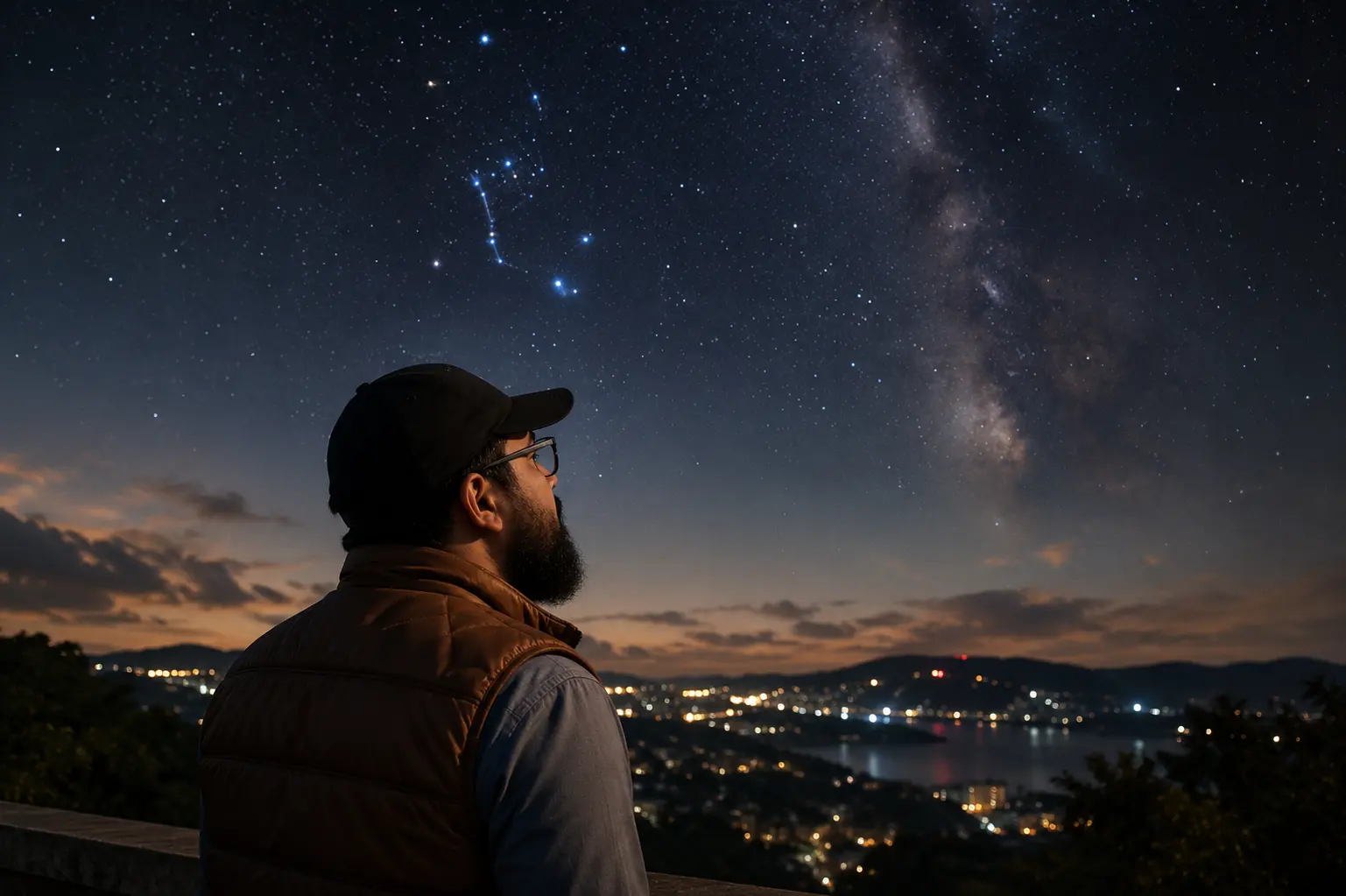
Hi, I’m Monjurul.I am a digital marketing freelancer based in Chittagong, Bangladesh. By profession, I spend most of my time helping businesses grow online, but outside of work, I have always been drawn to something much bigger than algorithms, rankings, or websites—the universe itself.Whenever the sky is clear, I enjoy looking up. I don’t own a telescope, at least not yet, but that has never stopped me from being fascinated by what lies beyond our planet. Sometimes all it takes is a dark sky, a few familiar constellations, and a curious mind.For me, space has never been just another topic to read about. It has been a lifelong curiosity—one that has quietly grown with me since childhood.This website is the result of that journey.
How My Curiosity Began
Like many children, my first introduction to space came through school textbooks.I still remember reading about the Earth, the Moon, the Sun, the planets, and our solar system. Those chapters felt different from every other subject. Instead of simply memorizing facts for exams, I found myself imagining distant worlds, wondering what existed beyond our tiny blue planet.As I grew older, my questions became bigger than my textbooks could answer.Back then, the internet wasn’t something people carried in their pockets. Computers were rare, and internet connections were even rarer. If you wanted to browse the web, you went to a cyber café.Around 2006 or 2007, two of my friends and I rented two computers for one hour. If I remember correctly, it cost around 50 or 60 Bangladeshi Taka for that hour, which felt like a significant amount at the time.Many people visited chat rooms or played games.I did something different.The very first website I searched for was NASA.I still remember the feeling of opening those pages filled with images of planets, rockets, astronauts, and galaxies. It felt like someone had opened a door to another universe. Until then, space had mostly existed inside schoolbooks and magazines. Suddenly, I was looking at real photographs from space missions and reading about discoveries made by scientists around the world.That one visit changed something inside me.
Learning Before Smartphones
Accessing information wasn’t easy in those days.Whenever I found newspapers, science magazines, or books that covered astronomy or space exploration, I read them eagerly. Unfortunately, those opportunities were limited. Space news wasn’t something local media covered in depth, and reliable educational resources in Bengali were extremely difficult to find.Years later, I got my first feature phone.Browsing the internet became possible, although it was slow and often frustrating. Still, I continued reading whatever I could find.Everything changed again in 2014 when I bought my first Android phone.For the first time, I could regularly follow international space news without depending on newspapers or occasional magazine articles. I began reading about the Apollo missions, the Mars rovers, Voyager, the International Space Station, planetary exploration, and the incredible engineering behind modern rockets.Every article led to another article.Every mission led to another question.And every answer reminded me how much more there was left to learn.Unlike many hobbies that fade over time, my interest in space only became stronger.
Small Moments That Stayed With Me
One of my favorite childhood memories involves the Orion constellation.After reading about Orion in a science magazine, I desperately wanted to find it in the night sky. I couldn’t identify it by myself, but my older brother patiently helped me recognize Orion’s Belt for the very first time.It may sound like a small moment.To me, it wasn’t.That night, the stars stopped being random dots scattered across the sky. They became something I could understand, recognize, and connect with.Even today, whenever I notice Orion during the winter months, I remember that evening.Another memory comes from lunar eclipses.Growing up, I heard many traditional beliefs surrounding eclipses. People often said you shouldn’t eat during a lunar eclipse or even immediately afterward. As a child, I accepted those ideas because everyone around me believed them.But the more I learned about astronomy, the more I realized how important scientific understanding is.Instead of fearing an eclipse, I became fascinated by the beautiful alignment of the Earth, Moon, and Sun that makes such an event possible.Those experiences taught me something valuable:Curiosity should always be stronger than superstition.
Why I Never Stopped Learning
Today, I still follow developments in space almost every day.NASA remains one of my primary sources, but I also enjoy reading updates from SpaceX and trusted science publications covering astronomy and space exploration. I closely follow missions involving Mars, the Moon, reusable rockets, exoplanets, cosmology, black holes, and new discoveries from the James Webb Space Telescope.One of the most unforgettable moments in recent years was seeing the first deep-space images released by the James Webb Space Telescope.Looking at galaxies whose light had traveled billions of years before reaching us was difficult to describe with words. Those images weren’t simply beautiful photographs—they were windows into the ancient universe.I also find reusable rockets incredibly inspiring.Watching a Falcon 9 booster descend from the sky and land vertically still feels almost unreal to me. Every successful landing reminds me that what once belonged to science fiction can eventually become engineering reality.Although I don’t own a telescope yet, I occasionally spend time observing the night sky whenever conditions allow. I also enjoy following the work of Bangladeshi astrophotographer Zobayer Kaolin, whose remarkable images continue to inspire people to appreciate the beauty of our universe.I hope to spend much more time observing the sky in the future.Because no matter how many articles I read, nothing compares to looking up and realizing that everything we know exists within an unimaginably vast universe.
The Gap That Inspired This Website
Over the years, I noticed something that bothered me.Whenever major discoveries happened—whether it was a Mars mission, a James Webb image, or a SpaceX launch—many local websites rushed to publish the news.Unfortunately, most of them simply translated or copied information from international sources.Very few actually explained the science behind the story.Often, it was obvious that the writer didn’t fully understand the subject. Important details were missing. Scientific terms were translated incorrectly. Headlines were exaggerated just to attract clicks, while older information remained online without updates or corrections.For someone genuinely interested in learning, this created a frustrating experience.As someone who had spent years reading original sources and following space exploration, I realized that the biggest problem wasn’t the lack of news.It was the lack of trustworthy explanations.People don’t just want to know what happened.They also deserve to understand why it matters.That realization became the foundation of everything I want this project to become.
What I Want This Website to Stand For
There is a quote often attributed to Carl Sagan that says, “Somewhere, something incredible is waiting to be known.” Whether or not we become scientists, I believe that curiosity itself has the power to change lives.That belief is the reason this website exists.When I was learning about space, I often wished there were resources that explained complex topics in simple language without sacrificing scientific accuracy. I wanted articles that didn’t just report a headline but helped readers understand the science behind it.Instead of asking readers to trust me simply because I write about space, I want to earn that trust through consistency, transparency, and accuracy.Every article I publish will be guided by a few simple principles.First, accuracy comes before speed.Breaking news is exciting, but publishing incorrect information helps no one. Whenever possible, I will verify information using official sources such as NASA, ESA, scientific publications, and other trusted organizations before publishing an article.Second, science should be understandable.Space science can sound intimidating because of technical terminology, but that doesn’t mean it has to be difficult to learn. My goal is to explain complicated concepts in a way that beginners can understand without oversimplifying the science behind them.Third, facts matter more than clicks.Unfortunately, sensational headlines have become common across the internet. They may attract visitors for a moment, but they rarely build trust. I have no interest in publishing exaggerated claims or misleading titles simply to increase page views.If a discovery is genuinely exciting, the science itself is already fascinating enough.Fourth, every article should teach something valuable.I don’t want readers to leave with just another headline in their memory.I want them to leave with a better understanding of our universe.Whenever appropriate, I also plan to include context, explain common misconceptions, and answer the questions that curious readers naturally ask after hearing about a new discovery.Science communication should help people think more critically, not just consume more content.
What You’ll Find Here
This website is built for anyone who has ever looked up at the night sky and wondered what lies beyond.Whether you’re completely new to astronomy or someone who already follows every rocket launch, I hope you’ll find something worth reading here.The topics I plan to cover include:Space News and major scientific discoveriesAstronomy and observational guidesRocket science and launch technologySpace technology and innovationMoon exploration missionsMars exploration and future colonization effortsBlack holes, galaxies, and cosmologyExoplanets and the search for habitable worldsJames Webb Space Telescope discoveriesHubble Space Telescope history and observationsSpace history and landmark missionsBeginner-friendly guides for anyone starting their journey into astronomyBeyond news, I want this platform to become a learning resource.Whenever a major event happens—whether it’s a rocket launch, a new telescope image, or a scientific breakthrough—I don’t want to simply repeat what everyone else is saying.Instead, I want to explain:What actually happened.Why it matters.How scientists discovered it.What questions still remain unanswered.Because understanding is far more valuable than simply knowing.My publishing goal is simple and realistic: to consistently publish high-quality articles that prioritize research over quantity. I’d rather publish one well-researched article than several rushed ones.
Looking Beyond Today’s Articles
Although this project begins as a website, I don’t see it ending there.My long-term vision is much bigger.I dream of building a trusted space education platform that inspires curiosity, encourages scientific thinking, and makes reliable space education more accessible to everyone.Growing up in Bangladesh taught me that access to quality educational resources is not always equal. Many talented students are deeply curious about science but don’t have easy access to books, communities, or learning opportunities.I hope this platform can help change that, even in a small way.One day, I would love to see this project grow into a space education foundation that supports science communication, creates educational resources in Bengali and English, and encourages more young people to explore astronomy, engineering, and space science.Perhaps it could organize educational events, collaborate with educators, or build a community where students can ask questions, learn together, and discover opportunities they never knew existed.Every meaningful journey starts with a single step.
Why This Matters to Me
People often ask why I spend so much time reading about something that seems so far away.My answer is always the same.Space isn’t just about distant galaxies.It’s about humanity.Every mission to Mars, every telescope pointed toward the edge of the observable universe, and every reusable rocket that lands safely back on Earth represents thousands of people working together to solve problems that once seemed impossible.Those achievements remind us of what human curiosity can accomplish.They remind us that progress begins with asking questions.As children, we naturally ask why.Somewhere along the way, many people stop asking.I don’t want to lose that habit.And I hope this website encourages others not to lose it either.
An Invitation
If you’ve read this far, chances are you share at least a little of the same curiosity that has guided me for so many years.Whether you’re here because you love astronomy, want to understand the latest space missions, dream of becoming an engineer or scientist, or simply enjoy looking up at the stars on a quiet night—you are welcome here.This isn’t just a collection of articles.It’s the beginning of a journey built on curiosity, evidence, and a genuine appreciation for the universe we all share.I don’t claim to know everything about space.In fact, one of the most beautiful things about astronomy is realizing how much remains unknown.I’ll continue learning.I’ll continue asking questions.And I’ll continue sharing what I discover along the way.If this website helps even one student understand the universe a little better, inspires one reader to question misinformation, or encourages one young dreamer to pursue a career in science, then every hour spent building it will have been worthwhile.Thank you for being here.Let’s keep looking up.