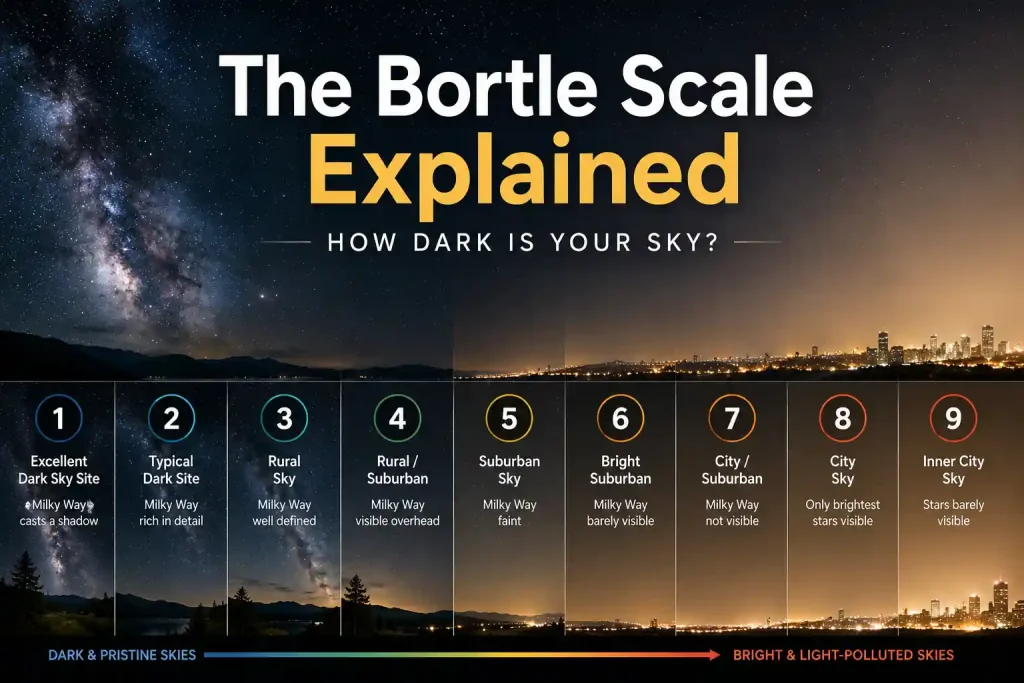
The Bortle scale is a 1 to 9 rating of how dark your night sky is. Class 1 is a pristine dark sky far from any city, and Class 9 is a brightly lit inner city. It was created by veteran amateur astronomer John E. Bortle and published in Sky & Telescope magazine in February 2001. The whole point of the scale is that it predicts what you can actually see: at Class 1 the Milky Way is bright enough to cast a shadow, while at Class 9 you get little more than the Moon, the brighter planets, and a scattering of stars. Lower number, darker sky, more to see.
If you have ever wondered why the sky looks so much richer on a camping trip than it does from your backyard, the Bortle scale is the answer. This guide explains what each class means in plain language, shows you how to find your own class in about two minutes, and tells you exactly what is worth observing where you live tonight.
What the Bortle Scale Is (and Who John Bortle Was)
John Bortle was a lifelong amateur astronomer and a longtime contributor to Sky & Telescope. He noticed that stargazers kept describing their skies in vague terms like "pretty dark" or "not great," which made it impossible to compare notes. So he built a nine-step ladder that ties a number to a set of things you either can or cannot see with your own eyes.
That last part is what makes the scale useful. Unlike a raw light-meter reading, the Bortle scale is defined by observable landmarks: whether the Milky Way is visible, whether you can spot faint galaxies like M33 (the Triangulum Galaxy), whether the zodiacal light shows up, and how many stars fill a familiar pattern like the Pleiades. Astronomers often pair it with a measurement called the naked-eye limiting magnitude, or NELM, which is simply the faintest star you can see straight overhead. A darker sky lets you see fainter stars, so the NELM number climbs as the Bortle class drops.
You do not need any gear to use the scale, which makes it one of the first things worth learning when you are starting out in stargazing. Once you know your class, every other decision (what to look for, whether to travel, whether binoculars are worth it) gets easier.
Find Your Bortle Class in 2 Minutes
You can look up your class right now, for free, without stepping outside.
- Use a light-pollution map. Open a site like lightpollutionmap.info or Dark Sky Finder in your browser. These overlay color-coded pollution data on a normal map. Type in your address and read the color where your house sits. The maps translate those colors into a Bortle class or an equivalent sky-brightness value.
- Cross-check with your own eyes. On a clear, moonless night, go outside and let your eyes adjust for at least 20 minutes (no phone screen). Then run two quick tests. Can you see the Milky Way as a faint band? Count the stars you can make out in the Pleiades cluster. Seeing 6 or more Pleiades stars points to roughly Bortle 1 to 4; seeing only 4 or 5 points to Bortle 5 to 6; seeing the Milky Way clearly overhead but not down at the horizon is a classic Bortle 5.
The map tells you what to expect, and your eyes confirm it. If the two disagree, trust your eyes on the night, because a stray streetlight or a bright neighbor can push your real conditions a notch worse than the map suggests.
The 9 Classes, Translated Into What You'll Actually See
Here is the full scale, rewritten from an academic checklist into plain terms. NELM values below follow Bortle's original published ranges.
| Class | Typical location | What the sky looks like and what's visible | NELM |
|---|---|---|---|
| 1 | Remote wilderness, deserts, high mountains | The darkest sky on Earth. The Milky Way casts a faint shadow. Zodiacal light and the elusive gegenschein show up. M33 is an easy naked-eye object. Genuinely overwhelming. | 7.6 to 8.0 |
| 2 | Truly rural, far from towns | The summer Milky Way is highly structured and detailed. M33 is easy to see. The sky is almost as good as Class 1 for most observers. | 7.1 to 7.5 |
| 3 | Rural sky | The Milky Way still shows real structure. Faint light domes glow over distant towns near the horizon. M33 needs averted (sideways) vision. Excellent conditions. | 6.6 to 7.0 |
| 4 | Rural/suburban edge, exurbs | The Milky Way is still obvious overhead but loses detail. Light-pollution domes are clear in several directions. A great compromise sky that many people can drive to. | 6.3 to 6.5 |
| 5 | Suburbs | The Milky Way is washed out overhead and gone near the horizon. Only hints of zodiacal light on the best nights. Bright deep-sky objects still reward a telescope. | 5.6 to 6.0 |
| 6 | Bright suburbs | The Milky Way shows only near the zenith, if at all. The Andromeda Galaxy (M31) is a faint smudge. The sky within about 35 degrees of the horizon glows gray-white. | 5.1 to 5.5 |
| 7 | Suburban/urban transition | The Milky Way is basically invisible. M31 and the Beehive cluster (M44) are barely glimpsed. The whole sky has a grayish cast. | 4.6 to 5.0 |
| 8 | City sky | Only the brightest star clusters and Messier objects can be pulled out with a telescope. Many constellations are hard to trace or missing entirely. | 4.1 to 4.5 |
| 9 | Inner city | The sky glows all night. The Moon, the bright planets, and a few of the brightest stars and clusters are all you get. Most constellations are simply gone. | 4.0 or less |
Notice that the Milky Way, the single most requested sight for beginners, disappears somewhere around Class 5 and is gone by Class 6 to 7. That one fact drives almost everything below.
What's Worth Observing at YOUR Class
Most guides stop at the table. But the real question is not "what class am I," it is "so what should I point at tonight?" Here is where your time is well spent, and where it is wasted.
City skies (Bortle 7 to 9). Do not chase faint galaxies and nebulae; they will not show, and you will only get frustrated. Instead, go after the bright targets that punch through light pollution: the Moon (endlessly detailed and best a few days from full), Jupiter and its four big moons, Saturn's rings, Venus, and Mars near opposition. Double stars, the Orion Nebula in winter, and the brightest star clusters also hold up. A city is actually a fine place to learn the planets, and a pair of binoculars goes a surprisingly long way here, as our guide to seeing the planets with binoculars explains.
Suburban skies (Bortle 5 to 6). You are in the sweet spot for learning the bright half of the deep sky. The Andromeda Galaxy, the Hercules Cluster, the Ring Nebula, and the brighter open clusters are all within reach of a modest telescope. The Milky Way peeks out overhead on the clearest nights, but do not expect the postcard version.
Rural skies (Bortle 3 to 4). Now the sky opens up. The Milky Way shows real structure, dozens of galaxies and nebulae become achievable, and the difference from a suburban night is night-and-day, literally. This is the class most beginners should aim to reach a few times a year, and it is where our guide to seeing the Milky Way really comes alive.
How to Buy Yourself 1 or 2 Classes
This is the part almost nobody tells beginners plainly, so here it is: most people live under Bortle 6 to 9 skies, and a short drive to a darker class will transform what you see far more than any gear upgrade. A tank of gas spent reaching a darker site does more for your view than the same money spent upgrading your telescope, every time.
You do not need to reach Bortle 1. The jump that matters most is the first one or two classes, because that is where the Milky Way and the brighter deep-sky objects switch on. Here is how to gain them cheaply:
- Drive 30 to 60 minutes away from the city center. Use a light-pollution map to pick a spot two or three color bands darker than home. In many regions that is enough to move from Bortle 7 to Bortle 4.
- Get behind a hill or tree line. Blocking the direct glow of a town, even without leaving your area, noticeably darkens the sky in that direction.
- Time it right. A moonless night matters as much as location. A full moon can wash out a rural sky down to something closer to suburban. Check a moon-phase calendar and aim for the week around the new moon.
- Shield local lights. At home, turn off porch and yard lights, and position yourself in the shadow of a building so no bulb shines directly in your eyes. Your dark adaptation is worth protecting.
Chasing darkness is a skill of its own, and it is the highest-leverage habit a new stargazer can build. Once you have felt the difference between your backyard and a true rural sky, you will understand why experienced observers plan whole trips around the Bortle scale.
FAQ
What Bortle class is a big city?
A large city center is typically Bortle 8 or 9, and dense inner cities sit firmly at Class 9. The immediate suburbs usually fall between Class 6 and 7. From these locations the Milky Way is invisible, but the Moon, planets, and bright clusters are still worth observing.
What Bortle class do I need to see the Milky Way?
You can catch a faint hint of the Milky Way overhead at Bortle 5. For a clearly visible band with some structure, aim for Bortle 4 or darker. For the jaw-dropping, detailed version that photographs well, you want Bortle 3 or below.
Is the Bortle scale the same as light pollution?
They are closely linked but not identical. Light pollution is the cause; the Bortle scale is a way to rate its effect on your view of the night sky. Two spots with similar pollution can score slightly differently based on altitude, air clarity, and nearby light sources.
Do I need a telescope to use the Bortle scale?
No. The scale is defined entirely by naked-eye observations, which is why it is a great first thing to learn. You just need a clear, moonless night and about 20 minutes for your eyes to adapt.
Can my Bortle class change?
The regional value is fairly stable, but your effective conditions shift with the moon phase, weather, air quality, and even new development or streetlights nearby. Local skies have generally been getting brighter over time as artificial lighting spreads, which is one reason dark-sky sites are worth protecting.