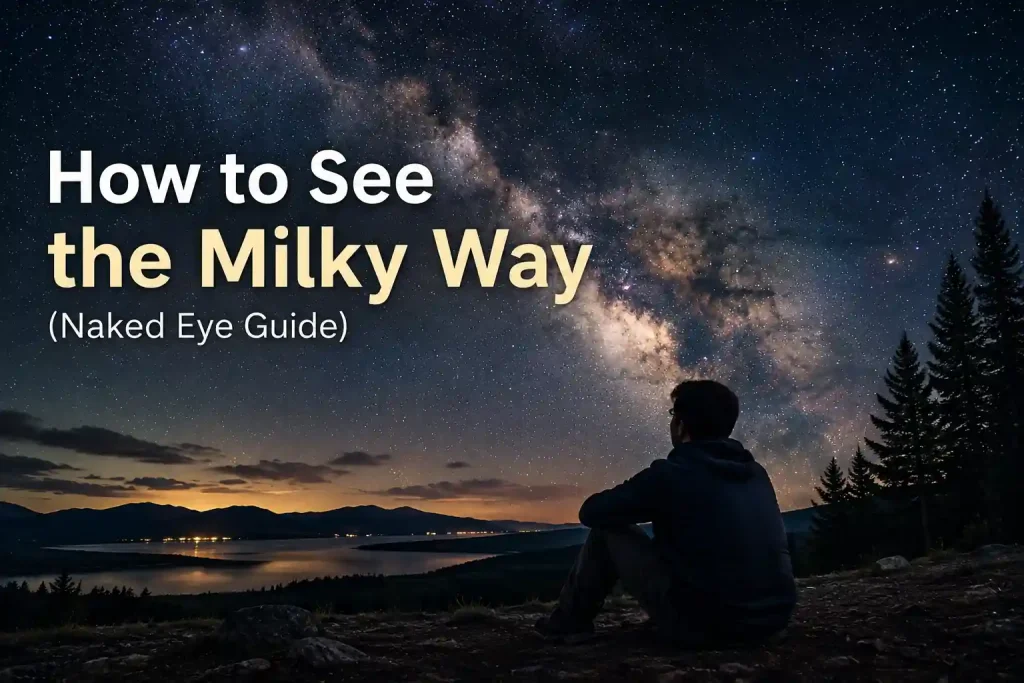
To see the Milky Way with your naked eye, you need three things at the same time: a genuinely dark sky far from city lights, a night with little or no moon, and the right season, when the bright galactic core is above your horizon. Get all three and no telescope is needed. You will see a soft, hazy band of light arching overhead. Miss any one of the three, and the galaxy stays invisible. This is why almost everyone who "can't see it" fails on conditions, not eyesight.
Below is exactly how to line up those three factors, what the Milky Way really looks like to human eyes, and how to troubleshoot a dark-site trip that shows you nothing.
What the Milky Way Actually Looks Like to Your Eyes
First, reset your expectations, because this is where most first-timers get discouraged. The Milky Way you see with your naked eye looks nothing like the glowing purple-and-orange photos on Instagram.
To your eyes, it is a faint, cloudy stripe of pale light stretching across the sky. It can look like a thin, motionless cloud that will not drift away, or like someone smudged a chalk line through the stars. In a truly dark sky it is genuinely striking, with visible dark rifts and brighter knots, but it is soft and colorless, not vivid.
Those saturated colors in photos are real, but they come from a camera, not from you. A camera collects light over a long exposure of many seconds; your eye refreshes constantly and cannot stack light that way. Your night vision is also nearly colorless, because the rod cells you see faint light with do not read color the way your daytime cone cells do. So the honest answer is: the photos are not fake, but they are not what you will see. Knowing that in advance is the difference between a magical night and a disappointing one.
The Number One Reason You Can't See It: Light Pollution
If you have never seen the Milky Way, light pollution is almost certainly why. The faint band is easily drowned out by the artificial skyglow over towns and cities. There is no trick, filter, or app that reveals it from a bright suburb. You have to physically travel to darker skies.
Astronomers rank sky darkness on the Bortle scale, a 1-to-9 rating where 1 is a pristine wilderness sky and 9 is an inner-city sky. Your Bortle class is the single best predictor of what you will see. Here is roughly what to expect:
| Your sky (Bortle class) | Typical location | What the Milky Way looks like |
|---|---|---|
| 1 to 2 | Remote wilderness, dark-sky reserves | Bright and detailed, with dark rifts; can be so bright it casts a faint shadow |
| 3 | Rural | Clearly visible and structured overhead |
| 4 | Rural / outer suburb edge | Visible overhead but washed out and dull near the horizon |
| 5 | Suburban | Faint at best, easily lost, mostly gone near the horizon |
| 6 to 7 | Bright suburb / town | Essentially invisible |
| 8 to 9 | City center | Invisible |
The takeaway: to reliably see the core of the Milky Way you generally want a Bortle 4 or darker site, and Bortle 1 to 3 is where it becomes unforgettable. If you are not sure how dark your area is, our guide to the Bortle scale explained walks through how to find your class and read a light-pollution map.
When to Look: Season, Time of Night, and the Moon
Here is the fact that trips up more people than anything else: the good part of the Milky Way is a seasonal target. The faint band is technically up year-round, but the bright, photogenic galactic core, the crowded center of our galaxy, is only above the horizon at night during part of the year. Point your eyes up in the wrong month and you are looking at the thin, dim outer arm instead.
Timing depends on your hemisphere.
Northern Hemisphere. The galactic core is best from roughly May to early October, with the peak around June and July. Early in the season (around March to May) the core only clears the horizon in the hours before dawn. By June through August it rises around sunset and is available for most of the night. By September into November it sits low in the early evening and then sets. From the northern half of the world the core never climbs very high, often only around 30 degrees above the southern horizon at its best, so you also want a clear, unobstructed view toward the south.
Southern Hemisphere. Observers south of the equator get the better deal. The core is well placed from about April to September, peaks around June to August, and rides much higher in the sky, passing nearly overhead from places like Australia, southern Africa, and Chile. That high angle means less atmosphere and skyglow in the way, and a far more dramatic view.
The moon is the second half of timing. A bright moon acts like natural light pollution and washes the Milky Way out completely. Plan your trip for the days around new moon, the roughly week-to-ten-day window when the moon is a thin crescent or absent from the night sky. A full moon night at a perfect dark site will still show you almost nothing. Season and moon phase have to line up together.
Where to Look: Finding the Galactic Core
From the Northern Hemisphere during core season, look toward the south, low to moderately high above the horizon. The brightest, busiest part of the band sits in the direction of the constellations Sagittarius and Scorpius. A useful landmark: Sagittarius contains a star pattern many people recognize as a "teapot" shape, and the Milky Way looks like steam rising out of its spout. That "steam" is the galactic core.
From the Southern Hemisphere, the same core region passes high overhead, so you look up rather than toward the horizon.
A free planetarium app on your phone (set to red-light or night mode so it does not wreck your vision) will point you to Sagittarius in seconds and confirm whether the core is up at your chosen time. If you are brand new to finding your way around the night sky, start with our beginner's guide to stargazing, which covers reading the sky and getting oriented.
Let Your Eyes Adapt (Most People Quit Too Early)
Even in a perfect dark sky, the Milky Way will not appear the instant you step out of a lit car. Your eyes need time to adjust, and this step is quietly the most important skill of all.
Dark adaptation is a real physiological process. In the first 30 minutes of darkness your eye's sensitivity increases enormously, by a factor of thousands, and full adaptation takes roughly 20 to 40 minutes. Serious observers give it even longer, because the rod cells responsible for faint-light vision keep improving for a couple of hours. Practically, give yourself at least 20 to 30 minutes outside before you judge whether you can see anything.
Two rules protect that hard-won adaptation:
- No white light. A single glance at a phone screen or a white flashlight can reset your night vision and cost you another 20 minutes. Use a dim red light instead. Red wavelengths barely affect the rod cells that power your night vision, which is exactly why astronomers, pilots, and submariners use red light in the dark. Turn your phone to red night mode and drop the brightness.
- Use averted vision. The center of your vision is poor in the dark; the sensitive rod cells sit off to the side. So do not stare straight at the Milky Way. Look slightly to one side of where it is, and it will brighten and reveal more structure in your peripheral vision. This one trick can be the difference between "I think I see something" and a clear view.
Step-by-Step: Your Milky Way Night
A simple checklist that puts all three factors together:
- Pick the season. Confirm the galactic core is up for your hemisphere (roughly May to October in the north, April to September in the south).
- Pick the moon. Choose a night within about a week of the new moon.
- Pick the place. Find a Bortle 4 or darker site on a light-pollution map. Darker is always better.
- Check the weather. You need clear skies. Clouds and haze end the night before it starts.
- Arrive with an unobstructed view toward the south (Northern Hemisphere) or straight up (Southern Hemisphere).
- Kill all white light and let your eyes adapt for 20 to 30 minutes minimum.
- Find Sagittarius and the core using a red-mode sky app, then use averted vision.
- Optional upgrade: sweep the band with binoculars.
You do not need a telescope for any of this. In fact a telescope's narrow view is worse for the Milky Way than your naked eye, because the band is huge and you want to take in the whole sweep. A pair of ordinary binoculars, on the other hand, is a wonderful and cheap upgrade: they resolve the hazy glow into countless individual stars and pick out bright star clusters and nebulae along the band. If you want to go that route, see our guide to the best binoculars for stargazing.
"I Went Somewhere Dark and Still Saw Nothing": Troubleshooting
This is the section most guides skip, and it is where real nights go wrong. If you made the drive and saw nothing, it is almost never your eyes. Run down this list:
- The moon was up. The most common culprit. Even a half moon badly washes out the band. Check the moon phase and moonrise/moonset times, not just the date.
- Wrong season or wrong hour. The bright core was below your horizon. In spring you may need to wait until the pre-dawn hours; in autumn it sets early. Confirm the core was actually up when you looked.
- You looked the wrong way. From the north you must have a clear view to the south. A hill, tree line, or town glow on the southern horizon can hide the best part.
- Not dark enough. A "dark-ish" spot 30 minutes from a city is often still Bortle 5 or 6. The town's skyglow can sit exactly where the low core is. You may need to travel farther.
- Not enough dark adaptation. If you only waited five minutes, or kept checking your phone, you never gave your eyes a chance. Reset and wait a full 20 to 30 minutes with no white light.
- Thin cloud or haze. High haze you cannot even see in the dark will quietly erase the faint band.
Fix the one that applies and try again. When all three big factors (dark site, no moon, right season) truly line up, the Milky Way is not subtle. It is a clear, glowing arch you will not forget.
FAQ
Can you see the Milky Way from a city or suburb?
No. City and bright-suburb skyglow completely drowns out the faint band, and no app or filter fixes that. You have to travel to a darker location, generally Bortle 4 or darker on the light-pollution scale.
Do you need a telescope to see the Milky Way?
No. The Milky Way is best seen with the naked eye, because the band spans the whole sky and a telescope's narrow field is too zoomed in. Binoculars are a nice optional upgrade that resolves the haze into individual stars, but they are not required.
What months is the Milky Way visible?
The bright galactic core is best from about May to early October in the Northern Hemisphere (peak June and July) and about April to September in the Southern Hemisphere (peak June to August). The fainter band is technically up year-round, but the impressive core is seasonal.
Why does the Milky Way look so much better in photos than in real life?
Cameras take long exposures that collect light over many seconds and record color, while your eye cannot stack light and sees faint objects in near-grayscale. The photos are real, but to your eyes the Milky Way is a soft, colorless band, not a vivid rainbow.
How long does it take for your eyes to adjust to see it?
Give your eyes at least 20 to 30 minutes in full darkness with no white light. Sensitivity climbs steeply in the first 30 minutes and keeps improving for hours. One look at a white phone screen can reset the process, so use a dim red light instead.