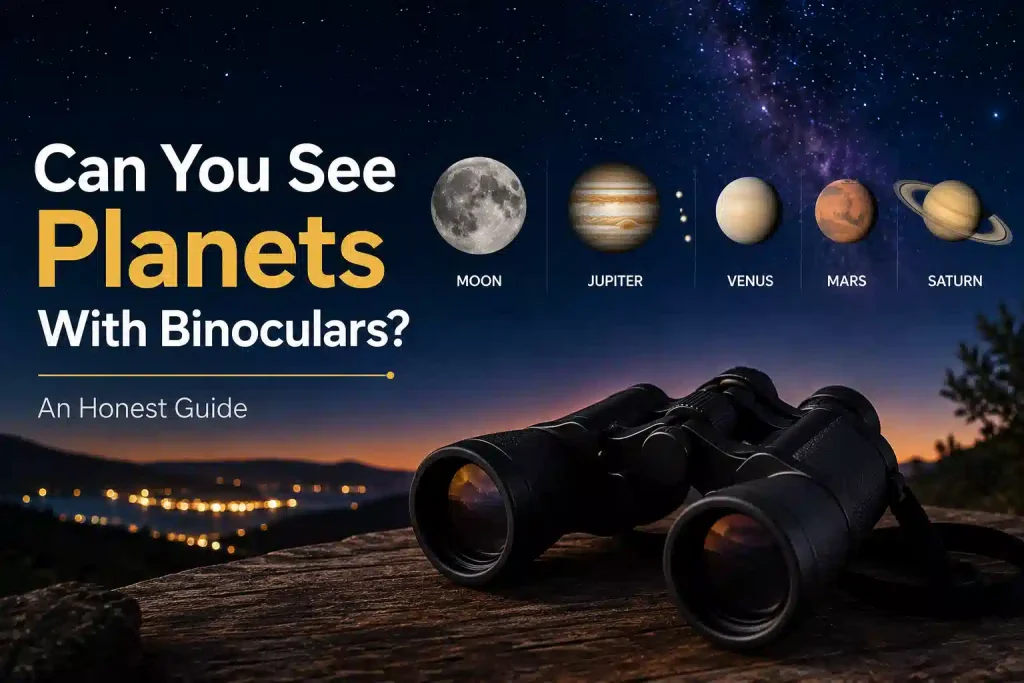
Yes, you can see planets with binoculars, but it helps to know what "see" honestly means first. A normal pair of binoculars will show you Jupiter with its four bright moons lined up beside it, the Moon's craters in crisp detail, and Venus and Mars as brilliant, colored points of light. What binoculars will not show you is Saturn's rings as clean, separated hoops, or surface detail on any planet. Those are telescope views. For a first look at the night sky, though, binoculars are one of the best tools you can pick up, and you may already own a pair.
If you have been staring at binoculars on a shelf wondering whether they are "enough" for astronomy, this guide walks through the sky planet by planet, so you know exactly what to expect before you go outside.
Any Binoculars Work, but 50mm Is the Sweet Spot
Here is the good news: the birdwatching or sports binoculars in your closet are fine to start. You do not need a special "astronomy" pair to begin.
That said, aperture matters more than magnification. The two numbers on your binoculars, like 7×50 or 10×50, tell you the magnification (7x or 10x) and the diameter of the front lenses in millimeters (50mm). The second number is the one that counts at night, because a wider lens gathers more light, and faint objects only reveal themselves when enough light reaches your eye.
- 7×50 is the classic stargazing choice. The wide field of view makes it easy to find things, and the modest magnification is forgiving of shaky hands.
- 10×50 trades a little steadiness for a bit more reach on planets and moons.
- Anything above about 12x usually needs a tripod, because your heartbeat and breathing will blur the view.
A 50mm front lens is the widely recommended minimum for comfortable night-sky viewing, and it is the size most stargazing guides point beginners toward. If you want a deeper breakdown of specs before you buy, our guide to the best binoculars for stargazing covers what to look for. But you can absolutely start with what you have tonight.
Planet by Planet: What You Will Actually See
Binoculars roughly double or triple what your naked eye can pull out of a planet, which is enough to change some of them from "a dot" into "a dot with something next to it." Here is the honest expectation for each planet, brightest and easiest first.
| Planet | What binoculars show | Difficulty |
|---|---|---|
| The Moon | Craters, dark maria, mountain ranges, sharp shadows near the terminator | Very easy |
| Jupiter | A small disk plus up to 4 moons as tiny "stars" in a line | Easy |
| Venus | A dazzling bright dot; a crescent shape only at its best | Easy to spot, hard to resolve |
| Mars | A distinctly orange-red point of light, no surface detail | Easy to spot |
| Saturn | A non-round, slightly oval "dot," but no separated rings | Moderate |
| Mercury | A bright point low near the horizon at dawn or dusk | Hard (timing) |
| Uranus | A faint blue-green star-like dot, needs a dark sky | Hard |
| Neptune | An extremely faint dot, effectively star-like | Very hard |
Jupiter and its four moons: the showpiece
Jupiter is the planet that turns a curious beginner into a hooked one. Through steady binoculars you will see the planet as a small, bright disk, and beside it, up to four pinpoints of light strung out in a rough line. Those are the Galilean moons: Io, Europa, Ganymede, and Callisto, the same moons Galileo spotted in 1610 with an instrument weaker than your binoculars. Watch across a few nights and you will see them shift position as they orbit. On some nights you will see all four; on others one or two hide behind or in front of the planet.
Venus: bright, but a tough phase
Venus is the brightest object in the sky after the Sun and Moon, so you cannot miss it. It looks like a brilliant white dot. Like the Moon, Venus goes through phases, and at its largest crescent phase, sharp-eyed observers with well-braced binoculars can just make out that it is not a perfect circle. This is at the very edge of what binoculars can do, and Venus's own glare fights you the whole way. Treat a glimpse of the crescent as a bonus, not the expectation.
Mars: color, not canals
Mars rewards you with unmistakable color. It is a small orange-red point, and binoculars intensify that hue nicely. What binoculars will not give you is any surface detail: no polar caps, no dark markings. Those need a telescope and a night when Mars is close to Earth. Enjoy Mars for its color and for the fact that you are looking at another world.
Saturn: the honest disappointment
This is the question everyone asks, so here is the straight answer: no, you will not see Saturn's rings clearly through binoculars. What you may notice, with a steady 10x or larger pair, is that Saturn does not look perfectly round. It reads as slightly stretched or oval, which is the rings blurring into the planet's shape. That "it's not quite a circle" moment is genuinely exciting once you know what causes it, but do not expect the postcard image. Saturn's largest moon, Titan, is visible only through large binoculars of around 60mm or more, and even then as a faint dot. The rings themselves belong to the telescope.
Mercury, Uranus, and Neptune: for the completionist
Mercury is bright but always hugs the horizon in twilight glare, so the challenge is timing and a clear, low view, not magnification. Uranus and Neptune are technically within reach: Uranus as a faint blue-green star, Neptune as an even fainter dot. Both require a genuinely dark sky and a star chart to know exactly where to point, because they look just like faint stars. Spotting them is a navigation exercise more than a viewing one.
The Best Binocular Target Is Not a Planet
Here is the thing most planet guides bury: planets are not what binoculars do best. Because binoculars offer a wide field of view and low magnification, they excel at large, faint objects that a telescope's narrow view actually struggles to frame.
- The Moon is the single best binocular target in the sky. Along the terminator, the line between lit and dark, craters throw long shadows and stand out in sharp relief.
- Star clusters are made for binoculars. The Pleiades resolve from a fuzzy smudge into a sparkling knot of blue stars. The Beehive Cluster and the Double Cluster in Perseus are stunning.
- The Andromeda Galaxy appears as a faint oval glow, the most distant object you can see, and binoculars make it far easier to find than a telescope does.
- The Milky Way breaks into countless individual stars and star clouds. Scanning it slowly on a dark night is one of the great free pleasures of stargazing, and our guide on how to see the Milky Way covers when and where to look.
If planets are the reason you picked up binoculars, let these become the reason you keep using them.
The Skill Nobody Teaches: Holding Them Steady
Magnification numbers get all the attention, but the single biggest upgrade to your view is free: hold the binoculars still. At 7x and 10x, tiny hand tremors are magnified along with the image, and a shaky view hides exactly the faint detail you are hunting for, like Jupiter's moons.
A few things that help more than buying a bigger pair:
- Brace your elbows against your chest, a wall, a fence, or the roof of a car.
- Sit or lie back in a reclining chair so your whole body supports the view.
- Use a tripod adapter. Most full-size binoculars have a threaded socket that accepts an inexpensive L-shaped adapter, turning any camera tripod into a rock-steady mount. This one accessory reveals more than jumping up a magnification class.
Steadiness is the difference between "I think I see a dot" and "there are the four moons."
Binoculars vs Telescope: When to Upgrade
Binoculars are a fantastic first instrument, and for a lot of people they are the only instrument they ever need. But be honest with yourself about the trade-off, because this is where money gets wasted.
Stay with binoculars if you love wide sweeps of the Milky Way, star clusters, the Moon, and finding your way around the sky. They are light, they need no setup, they work the moment you step outside, and they double as daytime binoculars.
Move to a telescope when the specific thing you want is planetary detail: Saturn's rings as separate hoops, Jupiter's cloud bands, the phases of Venus, or the polar caps of Mars. No pair of binoculars, at any price, will show you those. That is a limit of the tool, not of your eyes or your budget.
Many experienced observers keep both and reach for binoculars far more often than they expected. If you are just getting oriented under the stars, start with our beginner walkthrough on how to start stargazing, then decide what to buy after you actually know what you enjoy looking at.
FAQ
Can you see Saturn's rings with binoculars?
No, not as separate, distinct rings. Through steady 10x or larger binoculars, Saturn looks slightly oval rather than perfectly round, which is the rings blurring into the disk. Seeing the rings as clean hoops requires a telescope.
Can you see Jupiter's moons with binoculars?
Yes. This is one of the best sights in binoculars. Jupiter's four largest moons (Io, Europa, Ganymede, and Callisto) appear as tiny points of light in a line beside the planet, and their positions visibly change from night to night. Steady binoculars, braced or on a tripod, make them much easier to see.
Which planet looks best through binoculars?
Jupiter, because of its moons. It is the one planet where binoculars show you something clearly beyond a single point of light. The Moon, though not a planet, is the overall best target in the sky for binoculars.
Can you see planets with binoculars from a city?
Yes. The bright planets (Venus, Jupiter, Mars, and Saturn) cut through light pollution and are all visible from a city. Faint star clusters and galaxies suffer far more from city lights than the planets do, so a bright backyard is not a barrier to planet spotting.
Do I need special astronomy binoculars to see planets?
No. Ordinary birdwatching or sports binoculars work fine to start. A pair with 50mm front lenses is ideal for the night sky, but you can begin tonight with whatever you already own.