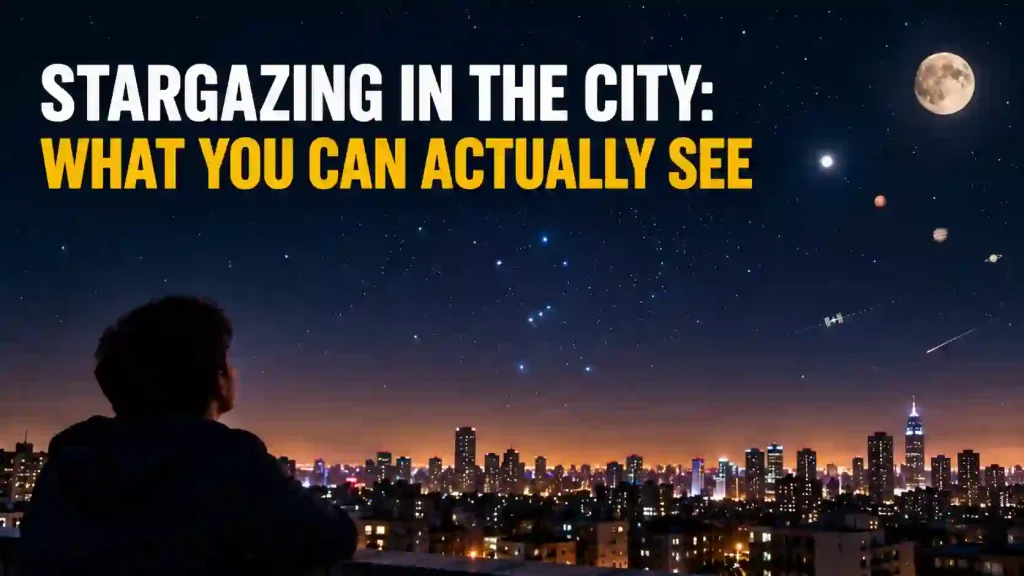
Yes, you can go stargazing from a city, and it's worth doing tonight rather than waiting for a trip to a dark-sky site. From a typical urban sky you'll still see the Moon in full detail, all five naked-eye planets when they're up, the brightest few dozen stars, recognizable patterns like Orion's Belt, and the International Space Station, which NASA notes can be spotted "even from the middle of a city" because it's brighter than any star. What you lose is the faint stuff: the Milky Way's band, dim deep-sky objects, and the fainter 95%+ of stars a dark site reveals. Light pollution is a spectrum, not an on/off switch, and where you fall on it determines exactly what's realistic tonight.
Light Pollution Is a Scale, Not a Verdict
The standard way astronomers describe sky darkness is the Bortle scale, a nine-level system running from Class 1 (the darkest skies on Earth) to Class 9 (brightly lit inner-city sky). It matters because "city" covers a huge range: a Class 6-7 suburb an hour from downtown is a genuinely different sky than a Class 9 block downtown, even though both would get called "the city" casually. Our guide to the Bortle scale explained walks through how to find your own number; this article focuses specifically on what each urban tier still gives you.
What's Actually Visible at City Light Levels
Here's the honest breakdown, tier by tier, based on Bortle scale descriptions:
- Bright suburbs (Bortle 6-7): The Milky Way is weak or absent to the naked eye, but the Moon, all visible planets, and roughly a few hundred of the brightest stars are still there. Well-known constellation shapes like Orion, the Big Dipper, and Cassiopeia remain findable.
- City sky (Bortle 8): Described as bright enough to read a newspaper headline outdoors without another light source. Only the brightest stars and planets punch through; faint constellations disappear, but the Moon and bright planets are unaffected.
- Inner-city core (Bortle 9): Only the very brightest handful of stars and planets remain visible. This is the true floor: even here, the Moon, Venus, Jupiter, and the ISS are still real targets.
In the darkest rural skies (Bortle 1-2), roughly 9,000 stars are visible to the naked eye; that number drops to around 900 in a town with moderate light pollution, and under 100 in a big city core, per commonly cited Bortle scale breakdowns. That's a real loss, but "under 100 stars" is still a real night sky, not nothing.
What Nobody Tells You to Actually Go Look At
Most city-stargazing advice either undersells what's available or tells you to drive somewhere else. Here's what's genuinely worth pointing at from a bright sky, tonight, without a car:
- The Moon. Unaffected by light pollution and arguably the single best target for city observers, especially around first quarter, when low-angle sunlight throws long shadows across craters and mountain ranges along the terminator, the line between the Moon's day and night sides. Binoculars turn this from good to genuinely striking.
- The naked-eye planets. Venus, Jupiter, Mars, Saturn, and Mercury are all bright enough to survive real light pollution when they're above the horizon. Our guide to telling a planet from a star covers how to pick them out once you're looking up.
- The International Space Station. NASA's own Spot the Station page calls the ISS "the third brightest object in the sky", after the Moon and Venus, and sightings work from dense urban areas specifically because the station is reflecting direct sunlight, not relying on a dark background. See our guide to spotting the ISS for how to get exact pass times for your address.
- A handful of bright constellations. Orion's three-star belt and the Big Dipper's bowl-and-handle shape are both bright enough to survive Bortle 7-8 skies, and both stay recognizable even when fainter patterns wash out completely.
- Bright conjunctions. When two planets, or a planet and the Moon, appear close together, the pairing is bright enough to notice even downtown, and it needs no dark-adaptation time to appreciate.
What Genuinely Doesn't Work From the City
Being honest about the limits matters more than padding the list. The Milky Way's band and core, faint deep-sky objects like most nebulae and galaxies, meteor showers below their brightest members, and the vast majority of stars fainter than magnitude 3-4 simply don't survive Bortle 7+ skies, no matter how long you wait outside or how good your eyes are. This isn't a gear problem or an effort problem; it's a physics problem, city sky glow adds background brightness that swamps anything faint. If the Milky Way's core specifically is your goal, our guide to the best time of year to see it is honest that it requires a genuinely dark site, not just patience.
Small Things That Make a Real Difference in a City
You can't out-wait light pollution, but you can improve your effective sky quite a bit within it:
- Get some distance from the nearest direct light source. Standing in a streetlamp's glare costs you more than the ambient city glow itself; a shaded spot, a rooftop, or the far corner of a park is a real, free upgrade.
- Let your eyes adapt anyway. Even in a bright sky, 15-20 minutes without checking a bright phone screen reveals more than you'd expect; see our guide to dark adaptation and red light for why this still matters even under light pollution, just with a lower ceiling than a dark site offers.
- Use binoculars. A pair of 7×50 or 10×50 binoculars gathers far more light than your eye alone and is genuinely one of the best upgrades available to a city observer; our beginner's binocular guide covers what to look for.
- Time it around the Moon and planets, not the Milky Way. Pick targets that survive your sky instead of chasing ones that structurally can't.
- Check ISS pass times specifically. It's one of the few "wow" targets that performs exactly the same from a city rooftop as from a dark-sky preserve.
The Honest Bottom Line
A genuinely dark site will always show you more, that's not in question. But "I live in a city" is not a reason to skip stargazing; it's a reason to pick different targets. The Moon, the planets, the ISS, and a handful of bright constellations don't care how much light pollution surrounds you, and that's a real night under the sky, not a consolation prize.
Frequently Asked Questions
Can you actually see stars from a big city?
Yes, but far fewer than a dark site: often under 100 versus roughly 9,000 in the darkest skies on Earth. The brightest stars and well-known patterns like Orion's Belt still punch through even Bortle 8 skies.
What's the best thing to look at from a city?
The Moon and the naked-eye planets (Venus, Jupiter, Mars, Saturn, Mercury) are the most rewarding city targets, since they're bright enough to be unaffected by light pollution. The International Space Station is also fully visible from dense urban areas.
Do I need to leave the city to see the Milky Way?
For the band and core, yes. The Milky Way needs genuinely dark skies, roughly Bortle Class 4 or darker for the core to become visible at all, which rules out most city and even bright-suburb locations.
Does light pollution ruin meteor showers too?
It sharply reduces what you'll see. Only the brightest meteors survive city sky glow, so you'll catch a fraction of what a dark-sky observer sees during the same shower, though the very brightest fireballs are still visible.
Is it worth buying binoculars if I only stargaze from a city?
Yes. Binoculars gather significantly more light than your naked eye and are one of the highest-value upgrades specifically for light-polluted skies, useful on the Moon, bright star clusters, and planets alike.