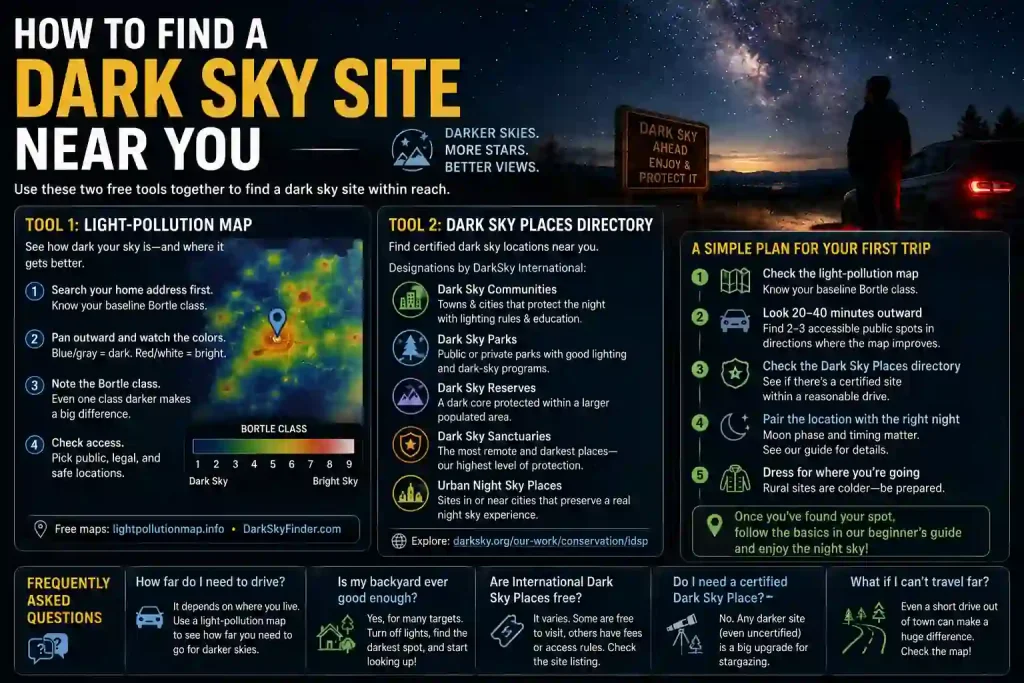
Finding a genuinely dark sky near you comes down to two free tools used together: a light-pollution map to see how bad things are close to home, and the International Dark Sky Places directory to find a certified dark location within reach. Start with the map, because it tells you something useful even if you never drive anywhere: exactly how much your own backyard is being washed out, and in which direction things get better. You do not need a wilderness reserve for a good first session, but knowing where the nearest real darkness is changes what you can plan for.
What "Dark Sky" Actually Means
Before finding a dark site, it helps to know what you are actually looking for. Light pollution is stray artificial light from streetlights, buildings, and cities that scatters into the night sky and washes out fainter stars, and it is the single biggest reason a backyard view and a rural view of the same sky can look completely different. NASA's own guidance on finding good stargazing spots is direct: the key is getting away from city lights to see more stars, and checking conditions like wind, temperature, and even wildfire smoke, which can all affect what you'll actually see on a given night.
Astronomers rate this on the Bortle scale, a 1-to-9 system running from pristine wilderness dark to inner-city sky. We cover the full scale in the Bortle scale explained, but the short version for this article: the lower the number, the darker the sky, and the more you'll see with nothing but your eyes.
Tool 1: Reading a Light-Pollution Map
NASA's own stargazing guidance points beginners to a specific method: visit a light-pollution map, search your location, and read the color-coded Bortle rating for your area and the areas around it. The map is built from real satellite data on artificial light, so it is not a guess: it shows measured skyglow, not just distance from a city on a road atlas.
What to actually do with it:
- Search your home address first. This tells you your realistic baseline, which is often worse than people expect even outside a downtown core.
- Pan outward and watch the colors change. Most maps shade from red/white (heavily light-polluted) through orange, yellow, green, and into blue/gray (genuinely dark). You're looking for the nearest patch of blue or gray you can realistically reach.
- Note the class, not just the color. A jump from Bortle 8 to Bortle 5 is already a dramatic improvement in what you can see, even if it isn't the darkest color on the map.
- Check a few candidate spots for accessibility, not just darkness. A locked gate or private land at 11 PM does you no good.
This single step answers the question most people are actually asking when they search for a dark sky site "near them": how far do I realistically need to go, and in which direction.
Tool 2: The International Dark Sky Places Directory
The second tool is more formal: DarkSky International, the nonprofit organization that runs official dark-sky certification, maintains a public directory of certified International Dark Sky Places. According to DarkSky International's own site, the program began in 2001 when Flagstaff, Arizona became the world's first recognized Dark Sky Community, and it has since grown into five official designation types:
- International Dark Sky Communities, towns and cities that have adopted quality outdoor lighting rules and public education efforts.
- International Dark Sky Parks, publicly or privately owned land protected for conservation, with good lighting and dark-sky programs for visitors.
- International Dark Sky Reserves, a protected dark "core" surrounded by a populated area with lighting policies to protect that core.
- Dark Sky Sanctuaries, the most remote and fragile of the designations, usually the darkest sites in the program.
- Urban Night Sky Places, sites inside or near cities that are actively managed to preserve a real nighttime experience despite nearby light.
That last category matters most for beginners: it means "certified dark sky site" does not automatically mean "hours from civilization." Some certified places exist specifically because they protect darkness close to where people already live.
You Don't Need a Certified Reserve for a Good First Night
It's worth saying plainly: a certified International Dark Sky Place is a bonus, not a requirement. NASA's own stargazing guidance treats "getting away from city lights" as a matter of degree, not an all-or-nothing trip. Moving from your lit street to a local park, a school field with the lights off, or the edge of town where the map shows even one Bortle class of improvement is a real, noticeable upgrade: more stars, a steadier sky, and often your first real glimpse of the Milky Way's glow if conditions are otherwise good.
Save the longer drive to a certified site for when you already know you like this hobby and want to chase specific targets like the Milky Way's core or a meteor shower under genuinely dark skies.
A Simple Plan for Your First Dark-Sky Trip
- Check the light-pollution map for your home location and note your baseline Bortle class.
- Look 20 to 40 minutes outward in whichever direction the map shows the fastest improvement, and identify two or three legally accessible spots (a public park, a boat launch, a rural pull-off).
- Check the Dark Sky Places directory for anything certified within a reasonable drive, in case there's an actual managed site nearby you didn't know about.
- Pair the location with the right night. A dark site under a full Moon still won't show you the Milky Way. See our guide to the best time of night to go stargazing for how to combine the two.
- Dress for where you're actually going. Rural sites are colder than your backyard, especially once you stop moving. If it's cold season, see what to wear stargazing in winter before you go.
Once you've found your spot, the basics from our beginner's guide to starting stargazing take over from there.
Frequently Asked Questions
How far do I need to drive to find a dark sky?
It depends entirely on where you live and how bad your local light pollution is. A light-pollution map will show your specific situation rather than a generic rule. NASA's guidance frames it simply as getting away from city lights; the map tells you exactly how far that needs to be from your location.
Is my backyard ever good enough?
Yes, for a lot of targets. Turning off your own porch light and picking the darkest corner of your yard is a real improvement over a fully lit street, and it's enough to see the Moon, bright planets, and many constellations. You'll need a genuinely dark site for fainter targets like the Milky Way.
Are International Dark Sky Places free to visit?
It varies by site and designation type: some are public parks with normal park access, others are private or reserve land with their own rules. Check the specific site's own listing before you go.
Do I need a certified Dark Sky Place, or just a dark spot?
Just a dark spot, for most beginner stargazing. Certification is useful when you're specifically chasing very faint targets or want a managed site with dark-sky programming, but an uncertified rural pull-off with a good Bortle rating works fine for regular stargazing.