The best time to go stargazing is not simply "after sunset." It is the point where three factors line up: the sky has reached true astronomical darkness, the Moon is out of the way or not overly bright, and you personally have enough time free to let your eyes adapt and actually see something. Get the timing wrong on any one of these and you can be standing under a technically clear sky seeing far less than you should. This guide walks through each factor and how to combine them, without inventing a single "best hour" that ignores your season and location.
Factor 1: Twilight, Not Sunset, Is What Actually Matters
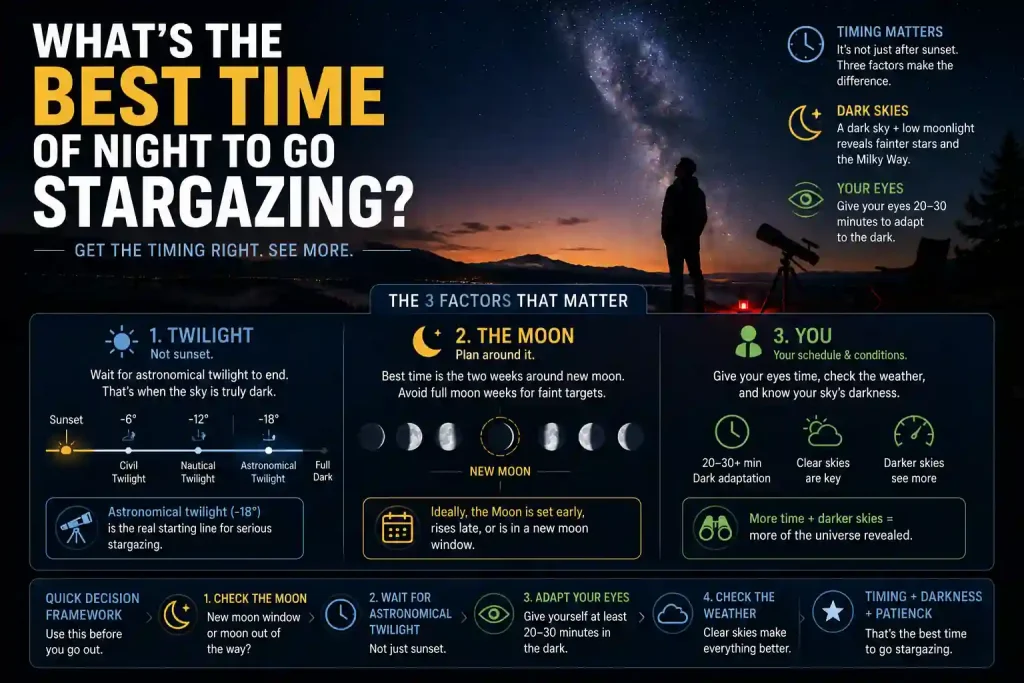
Sunset is not when the sky goes dark. The U.S. Naval Observatory, the official U.S. authority on these definitions, breaks the transition into three stages based on how many degrees below the horizon the Sun's center sits:
- Civil twilight ends when the Sun is 6 degrees below the horizon. Artificial lighting is typically still needed outdoors, and only the brightest stars and planets are visible.
- Nautical twilight ends at 12 degrees below the horizon, dark enough that the horizon line is still visible on a moonless night.
- Astronomical twilight ends at 18 degrees below the horizon. Past this point, per the U.S. Naval Observatory, scattered sunlight in the atmosphere becomes less than the natural light from stars themselves, meaning the sky has stopped getting meaningfully darker.
The practical takeaway: "after sunset" can still be too bright for fainter objects. Astronomical twilight's end is the real starting line for serious naked-eye or binocular observing, and depending on your latitude and the season, that can be well over an hour after sunset, not just a few minutes.
Factor 2: Where the Moon Is Tonight
The Moon is the single biggest sky-brightness variable you can actually plan around, since you know exactly where it is on any given night.
NASA's guidance is direct: "the best time to observe the stars, with regard to the Moon's brightness, is the two weeks before and after the new moon phase." In the week or so surrounding a full moon, NASA notes the Moon "is quite bright, and creates a lot of skyglow," which washes out fainter stars and makes targets like the Milky Way difficult or impossible to see. NASA describes the ideal condition as the Moon being "either absent from the sky all night, or sets within a couple of hours after sunset, or doesn't rise until the pre-dawn hours."
This does not mean a bright Moon ruins every session. The Moon itself is one of the best beginner targets there is, and bright planets and the brightest stars still show up fine under moonlight. It specifically matters for fainter targets: the Milky Way, faint clusters, and a genuinely dark, star-saturated sky. Our guide to how to see the Milky Way with the naked eye leans directly on this new-moon timing.
Factor 3: Your Own Schedule and Sky Conditions
The first two factors describe the sky. This one is about you, and it is the factor most guides skip entirely.
Dark adaptation takes real time. NASA puts full sensitivity at "half an hour or more," and cutting your session short before your eyes finish adapting means you never see what a longer session would have shown you. Our full breakdown in dark adaptation and red light covers the exact timeline and what resets it. If you only have 30 minutes total, budget for a noticeably fainter sky than someone staying out for an hour or two.
Sky darkness where you actually are matters as much as the clock. Astronomical twilight and moon phase describe the sky's baseline; your local light pollution sets a ceiling on top of that no amount of good timing can fix. If you are not sure how dark your area gets, our guide to the Bortle scale explained walks through checking it.
Weather is the wildcard. Clear-sky forecasts change, and none of the timing above matters under cloud cover. Check the forecast the same day, not days in advance.
Putting It Together: A Simple Decision Framework
For any given evening, work through it in this order:
- Check the Moon phase first. If you are chasing faint targets like the Milky Way, are you within roughly two weeks of new moon, or will the Moon set early / rise late enough to stay out of the way?
- Wait for astronomical twilight to end, not just for sunset. Look up your local twilight times rather than guessing; they shift meaningfully with season and latitude.
- Budget at least 20 to 30 minutes of dark-adapted time once you arrive, longer if you can manage it.
- Confirm the weather same-day, since a forecast from earlier in the week can be stale by evening.
None of this requires special gear or a perfect night. It just means picking your window on purpose instead of walking outside the moment it looks dark and wondering why the sky looks thin.
What About Late Night vs. Early Evening?
A common piece of advice is that later is always better, and there is some truth to it: later in the evening generally means you are further past astronomical twilight, the Moon (if it is up) has had more time to set, and casual outdoor lighting from neighbors and businesses tends to reduce as the evening goes on. But "later is better" is not automatic. A late-rising Moon can make midnight worse than 9 PM on a given night, and a clear early evening beats a clouded-over midnight every time. Rather than defaulting to a specific "best hour," it is more honest to say: run the three-factor framework above for your actual night, because the right hour changes with the season, your latitude, and that month's moon phase.
If you are still new to this and want the full first-session walkthrough before worrying about optimal timing, our beginner's guide to starting stargazing is the place to start. And once you know roughly when to go out, a sky app that shows moonrise/moonset and twilight times for your exact location makes this whole framework much easier to apply on the fly; see our roundup of the best free stargazing apps.
Frequently Asked Questions
Is midnight really the best time to stargaze?
Not automatically. Midnight tends to be past astronomical twilight and later than most casual outdoor lighting, which helps, but a bright, late-rising Moon or clouds can make midnight worse than an earlier clear window. Run the twilight, Moon, and personal-schedule factors for your actual night rather than defaulting to a fixed hour.
Does the best time change with the seasons?
Yes. How long after sunset astronomical twilight ends shifts with the season and your latitude, and the Moon's phase and rise/set times change throughout each month regardless of season. There is no single fixed clock time that works year-round.
What if I only have 30 minutes free?
You can still stargaze, but expect a fainter view, since NASA describes full dark adaptation as taking half an hour or more. Pick easy, bright targets, the Moon, the brightest planets, well-known constellations, rather than faint targets like the Milky Way that need longer adaptation and a darker sky.
Do I need to wait for a specific Moon phase every time?
Only if you are targeting faint objects like the Milky Way or dim star clusters. Bright targets, the Moon itself, planets, and prominent constellations, are visible regardless of Moon phase.
Is "after sunset" close enough, or do I really need to wait for astronomical twilight?
For a quick look at the Moon or a bright planet, sunset is fine. For a real stargazing session aimed at fainter stars, waiting for astronomical twilight's end makes a genuine difference, since the sky is still measurably brightening from scattered sunlight before that point, per the U.S. Naval Observatory.