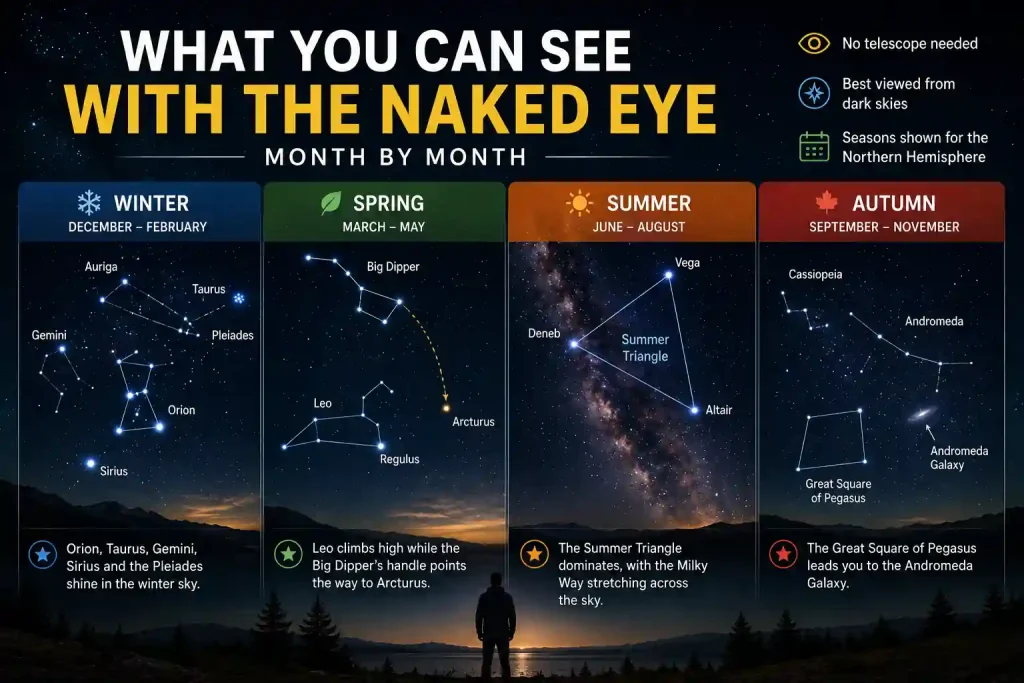
Different bright stars and constellations dominate the evening sky depending on the time of year, because Earth's orbit changes which stars we face after dark. In the Northern Hemisphere, winter evenings belong to Orion and Taurus, spring to Leo and the Big Dipper, summer to the Summer Triangle and the Milky Way's core region, and autumn to the Great Square of Pegasus and the Andromeda Galaxy. This guide is organized by season rather than exact date, because precise rise times and events shift year to year; for those, NASA's own monthly "What's Up" series is the source to check.
One honest caveat before you start: this is a Northern Hemisphere, mid-latitude guide. If you are south of the equator, these seasons and constellation positions do not apply the same way, and you will want a Southern Hemisphere-specific reference instead.
Winter (December–February): Orion, Taurus, and the Bright Dogs
Winter evenings feature what NASA's "What's Up: January" skywatching guide describes as a sky "filled with bright stars in the constellations Orion, Taurus, Gemini, Canis Major and Canis Minor."
Orion is the anchor. Its three-star belt is one of the most recognizable patterns in the entire sky and a genuinely easy first constellation for a beginner to learn. Just to Orion's upper right sits Taurus, the bull, home to two naked-eye star clusters worth specifically looking for: the Hyades (a loose V-shaped cluster) and the Pleiades (a tight, sparkling group often mistaken for a "little dipper"). East of Orion, the bright pair Castor and Pollux mark the heads of the twins in Gemini, per NASA. Canis Major and Canis Minor, the two dogs, round out the group, with Canis Major hosting Sirius, the sky's brightest star.
Winter's advantage for beginners is practical, not just visual: darkness falls early, so you do not need to stay up late to catch a good sky.
Spring (March–May): Leo and the Big Dipper's Handle
As winter's constellations sink toward the west, Leo the lion climbs into prominence. NASA's Night Sky Network describes Leo's distinctive shape as a "forward sickle, or reverse question mark," easy to spot climbing the southeastern sky after sunset, with the bright star Regulus marking the bottom of that curve.
Spring is also when the Big Dipper, the seven-star pattern most people already recognize inside Ursa Major, rides high overhead in the evening. NASA's "What's Up" guides describe a classic star-hopping trick from here: follow the curve of the Dipper's handle outward and you arrive at Arcturus, a bright, noticeably orange-tinted star in the constellation Boötes. This "arc to Arcturus" technique is one of the most reliable ways to teach yourself a new star, because the Big Dipper is easy to find first and the curve does the rest of the work.
Summer (June–August): The Summer Triangle and the Milky Way's Glow
Summer evenings bring the Summer Triangle, an asterism (a recognizable star pattern that isn't an official constellation) formed by three bright stars: Vega in Lyra, Altair in Aquila, and Deneb in Cygnus. According to NASA's Night Sky Network, the Summer Triangle is visible for most of the year from northern latitudes but becomes particularly prominent, riding high overhead, during the summer months.
What makes the Summer Triangle worth learning specifically is its location: it sits in a rich field of the Milky Way, with the galaxy's glow arching through the sky between Vega and Altair. If your sky is dark enough (see our guide to the Bortle scale to check), this is your seasonal window for the Milky Way to actually show itself as a visible band rather than a rumor; we cover exactly how and when in how to see the Milky Way with the naked eye.
Autumn (September–November): The Great Square and the Andromeda Galaxy
As summer fades, the Great Square of Pegasus rises into evening prominence. NASA's Night Sky Network describes it as a "handy guidepost" once you can find it, useful for locating several dimmer zodiac constellations nearby. Three of its four corner stars technically belong to Pegasus; the fourth, Alpheratz, is actually the brightest star in the neighboring constellation Andromeda.
Autumn's headline target is the Andromeda Galaxy itself, findable using either the Great Square of Pegasus or the distinctive W-shaped constellation Cassiopeia as a guide, per NASA. To the naked eye, NASA describes it as appearing as "a 3.4 magnitude patch of haze," dim because it sits roughly 2.5 million light-years away, but genuinely visible from a dark sky site, with surprising detail resolving once your eyes are properly dark-adapted (our guide to dark adaptation and red light covers the timing that makes the difference). Even from light-polluted areas, NASA notes that hints of it can sometimes still be made out.
How to Actually Find These, Not Just Read About Them
Reading a list of constellation names is not the same as finding them under a real sky. Two things make it click:
- Star-hop from something you already know. The techniques above (belt of Orion, handle of the Big Dipper, corners of the Square) all work by using one easy-to-spot pattern to point you toward the next one. Learn them in that order rather than trying to memorize the whole sky at once.
- Cross-reference with an app in the moment. A sky-identification app confirms in seconds what you are looking at and adjusts automatically to your exact date, time, and location, which this guide deliberately does not attempt since those specifics change constantly. Our roundup of the best free stargazing apps covers the free options worth having on your phone.
If you are brand new to this and want the full first-night walkthrough before diving into seasonal targets, start with our beginner's guide to stargazing.
Frequently Asked Questions
What is the best month to start stargazing?
There is no single best month; each season has strong naked-eye targets. Winter is popular with beginners because it gets dark early and Orion is an easy first constellation to learn. Whatever month you start in, this guide's seasonal section applies.
Does this guide apply if I live in the Southern Hemisphere?
No. This is a Northern Hemisphere, mid-latitude guide. Southern Hemisphere skies show different constellations at different times of year, and you would need a Southern Hemisphere-specific reference.
How often does the visible sky actually change?
The backdrop of stars and constellations shifts gradually through the year as Earth orbits the Sun, which is why this guide is organized by season rather than by exact date. Specific events (meteor showers, planet positions, exact rise times) change year to year and are not covered here; NASA's monthly "What's Up" skywatching guide is the source for those.
Do I need dark skies to see any of this?
Not entirely. Orion's belt, the Big Dipper, and the Summer Triangle's brightest stars are visible even from fairly light-polluted areas. Fainter targets like the Milky Way's glow and a clearly detailed view of the Andromeda Galaxy need a darker sky; check your area's darkness with our guide to the Bortle scale explained.
Can I see all of these constellations on the same night?
No single night shows every constellation in this guide, since they belong to different seasons and some are below the horizon or too close to the Sun at other times of year. That is exactly why the guide is organized season by season rather than as one combined list.