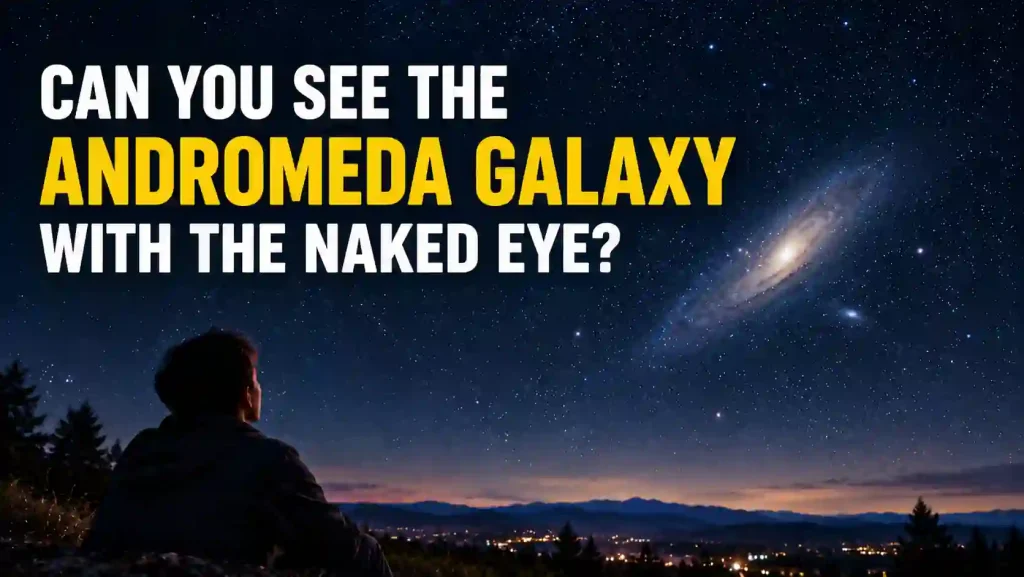
Yes. Under a genuinely dark sky, the Andromeda Galaxy is visible to the naked eye as a small, elongated smudge of haze, never as a spiral. NASA's Night Sky Network describes it as a 3.4 magnitude patch of haze, and says surprising amounts of detail can be seen with unaided eyes from dark sky sites, while hints of it can still be made out from light polluted areas. Your sky decides the answer far more than your eyesight does.
What You Actually See, and What You Do Not
Set your expectations before you go outside, because this is where most first attempts go wrong. You are not going to see the object from the photographs. Those images are long exposures that collect light for minutes or hours; your eye collects light for a fraction of a second and then starts over.
What you see instead is a soft oval of gray light, slightly brighter in the middle and fading at the edges, with no color and no visible arms. It is often described as looking like a thumbprint smudged on the sky, or like a faint cloud that does not move while the real clouds do. If you have ever glimpsed something at the edge of your vision and turned to look at it only for it to vanish, you already know the sensation this object produces.
That soft oval is a galaxy of hundreds of billions of stars. According to NASA, Messier 31 is the closest spiral galaxy to the Milky Way, at a distance of about 2.5 million light-years (read September 8, 2026). The light landing on your retina left before our species existed.
How Dark Must Your Sky Be to See the Andromeda Galaxy With the Naked Eye?
There is no single magnitude threshold that decides this, because it depends on your sky, your altitude, the air's transparency on the night, the Moon, and your own eyes. What is reliable is the direction of the effect. The darker the sky, the easier this gets, and the difference between a suburban garden and a properly dark site is not a small improvement, it is the difference between "nothing there" and "obvious once you know where to look".
The practical way to answer it for your own location is to grade your sky first. Our guide to the Bortle scale and how dark your sky really is gives you a class number for where you live, and the honest reading is that this target gets steadily easier as you move down the scale toward genuinely rural skies.
The mechanism behind the problem is scattered artificial light. DarkSky International, formerly the International Dark-Sky Association, defines skyglow as the ever-present haze of light over cities at night that comes from ground lighting scattering in the atmosphere and back to our eyes, blotting out the stars (read September 8, 2026). Our explainer on what light pollution is and why it ruins stargazing covers how that haze raises the background brightness of the whole sky, which is exactly the thing a faint, spread-out object cannot compete with.
Why Magnitude 3.4 Is Misleading
Here is the part almost nobody explains, and it is the reason people who can easily see magnitude 5 stars still fail to find Andromeda.
Magnitude 3.4 is an integrated figure. It describes all of the galaxy's light added together, as though every photon arrived from a single point. A magnitude 3.4 star really is a point, so all that light lands on a tiny patch of retina and looks obviously bright. Andromeda spreads the same quantity of light across a large area of sky, so at any given spot on your retina the object is far fainter than the number suggests.
That is why surface brightness, not magnitude, is what your eye is actually judging. It is also why a bright sky background hurts extended objects like galaxies and nebulae far more than it hurts stars. A star can stay visible against a mildly glowing sky because it is concentrated. A galaxy simply blends into the glow.
The practical consequence is simple. Do not decide whether you should be able to see Andromeda by asking how faint a star you can see. Decide it by how dark and how uniform your background sky is.
How to Find and See the Andromeda Galaxy With the Naked Eye
NASA's Night Sky Network gives the two standard routes, and both work with nothing but your eyes. Use the Great Square of Pegasus or the constellation Cassiopeia as guides (read September 8, 2026), since the galaxy sits near the border between Andromeda and Cassiopeia.
The Cassiopeia route is the easier one for beginners. Cassiopeia is the bright W or M shape of five stars, and the deeper V of that W acts like a rough arrowhead pointing toward the galaxy. Follow that direction by roughly the width of the W itself and you are in the right neighborhood. If you can already find the Big Dipper and use it to orient yourself, Cassiopeia sits on the opposite side of Polaris from it, which makes the whole northern sky navigable from one starting point.
The Pegasus route runs from the top left corner star of the Great Square, along a chain of stars curving up and to the left, then takes a short hop upward from the second bright star in that chain. Either way, the last step is the same. Stop looking directly at the spot and look slightly to one side of it. This is called averted vision, and it works because the light-sensitive cells that handle faint light sit away from the very center of your retina.
Give Your Eyes the Time They Need
Almost every failed attempt shares one cause. The observer walked outside from a lit room, looked up for two minutes, saw nothing, and went back in.
Your eyes need a sustained stretch of darkness before faint objects appear at all, and a single glance at a phone screen or a white flashlight undoes a large part of that progress. Our article on how long dark adaptation actually takes walks through the timeline and what resets it. For this target specifically, plan on being outside and away from white light for a good while before you make any judgment about whether the galaxy is visible, and use a red light if you need to see your feet or a chart.
Two other habits help. Keep the Moon out of the equation by choosing a night near new Moon, and let your eyes wander around the field rather than staring, since a faint smudge tends to announce itself when you are not fixating on the spot.
Naked Eye, Binoculars or Telescope
If your sky is not dark enough, binoculars solve the problem faster and more cheaply than driving anywhere. NASA's Night Sky Network notes that through binoculars M31's bright core stands out along with a bit of its wispy, saucer-shaped disc, while telescopes bring out greater detail and can reveal its orbiting dwarf galaxies M110 and M32.
| Tool | What Andromeda looks like | What it demands of you |
|---|---|---|
| Naked eye | A faint gray oval, brighter in the middle, no structure | A dark sky and dark-adapted eyes |
| Binoculars | An obvious bright core with a hint of the surrounding disc | Steady hands or something to lean on |
| Small telescope | Core plus more of the disc, and the two companion galaxies | Finding it, which is harder at high magnification |
Counterintuitively, a telescope is not automatically the best tool here. The galaxy is large on the sky and a telescope's narrow field of view can show a piece of the core with no context around it, so people sometimes look straight at it without realizing what they are seeing. Our guide to choosing binoculars for stargazing explains why a wide field and a bright image beat raw magnification on targets like this one.
Frequently Asked Questions
Is the Andromeda Galaxy the farthest thing you can see with the naked eye?
It is commonly described that way, and it is certainly the most distant object the overwhelming majority of people will ever see unaided, at about 2.5 million light-years according to NASA. A few observers with exceptional skies and long experience report seeing more distant galaxies, so treat "the farthest" as a well-earned reputation rather than a strict record.
Can I see Andromeda from a city?
Sometimes, partially. NASA's Night Sky Network says persistent stargazers can still spot M31's core from areas of moderate light pollution as long as the skies are otherwise clear. From a heavily lit city center, expect to need binoculars.
What time of year is best?
The constellation Andromeda becomes prominent as autumn arrives in the Northern Hemisphere, which is when the galaxy rides high in the evening sky. It can be found across a wider stretch of the year at less convenient hours.
Why does it look nothing like the photographs?
Photographs are long exposures that accumulate light and record color; your eye does neither. Your eye's low-light cells also do not register color, so even a bright view through a telescope stays gray.
Does averted vision really work, or is it a trick?
It is a real effect. The cells responsible for faint-light vision are concentrated away from the center of your retina, so looking slightly to the side of a faint object puts its light onto more sensitive tissue.
If none of this has worked for you yet, the problem is usually preparation rather than eyesight. Our complete beginner's guide to starting stargazing covers picking the night, the site and the habits that make faint objects possible in the first place.