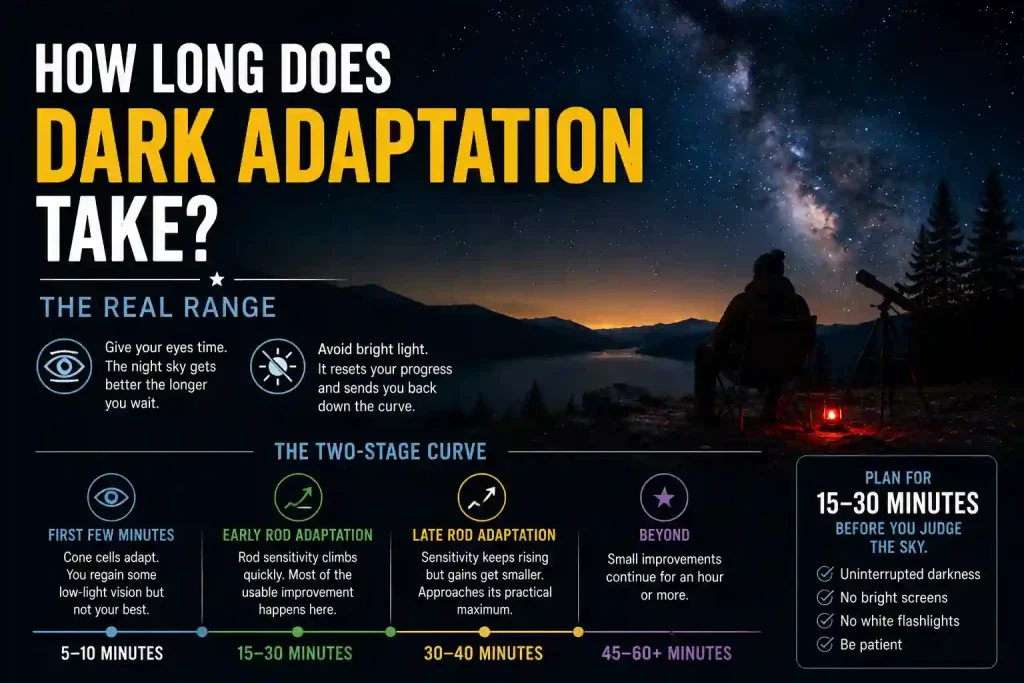
Plan for at least 15 to 30 minutes standing in genuine darkness before you judge what the night sky actually looks like. That is the practical, usable answer, sourced across several named authorities. But your eyes keep improving beyond that point too, with real (if smaller) gains continuing for an hour or more. If you have been outside 10 minutes and still see almost nothing, you are not doing anything wrong. You are simply not there yet.
Why You'll See Different Numbers on Different Sites
Search around and you will find "15 minutes," "20 minutes," "30 minutes," and "40 minutes" all stated as if they are the same fact. They are not contradicting each other so much as answering slightly different questions, because "dark-adapted" does not mean one single thing.
Your retina has two kinds of light-sensing cells. Cones handle color and detail and adapt to darkness fast, within several minutes. Rods handle low-light, black-and-white sensitivity and are what actually let you see faint stars, and they keep improving on a much longer timeline. A source describing "how long until you can see reasonably well" is answering a different question than one describing "how long until your rods reach their technical maximum sensitivity," and both are valid, just aimed at different levels of precision.
The Two-Stage Curve, Explained
This site's full explainer on dark adaptation and red light covers the mechanism in depth (rods, cones, and the light-sensitive pigment rhodopsin that darkness rebuilds and light breaks down). Here is the timing specifically, layered from two kinds of source: practical stargazing guidance and clinical vision science.
On the practical side, NASA describes full sensitivity as taking "half an hour or more," and the Royal Observatory Greenwich recommends waiting at least 15 minutes before judging what you can see.
On the more clinical side, Webvision, the vision-science reference published by the University of Utah's Moran Eye Center and hosted by the National Institutes of Health's National Center for Biotechnology Information, describes the same process as two distinct stages: cone sensitivity recovers substantially within about 5 to 10 minutes, while rod sensitivity continues recovering for roughly 20 to 40 minutes before the curve flattens out near its maximum.
Put together, that is not a contradiction. It is one curve, described at different resolutions:
| Stage | What's happening | Rough timeframe |
|---|---|---|
| First few minutes | Cone cells adapt; you regain some low-light vision but not your best | 5-10 minutes |
| Early rod adaptation | Rod sensitivity climbs quickly; most of the usable improvement happens here | 15-30 minutes |
| Late rod adaptation | Sensitivity keeps rising but gains get smaller; approaches its practical maximum | 30-40 minutes and beyond |
What Actually Resets the Clock
None of this matters if a bright light interrupts it, and this is the part beginners underestimate most. A glance at a phone screen at full brightness, a car's headlights sweeping past, or a friend's white flashlight all cost you real, measurable progress, sending you back down the curve rather than just pausing it. Our full breakdown of what wrecks dark adaptation and how to protect it covers this in detail, including why red light specifically (not just dim light) is the standard fix.
So What Should You Actually Plan For?
For practical stargazing purposes, budget a minimum of 15 to 30 minutes of uninterrupted darkness before you evaluate the sky honestly, and understand that a longer session (45 minutes to an hour) will reveal a genuinely fainter, richer sky than a short one. This matters most when you are also choosing when to go out in the first place; our guide to the best time of night to go stargazing walks through picking a window that gives adaptation time to actually pay off.
It is also worth knowing that a dark sky rewards this patience far more than a bright one does. Under heavy light pollution, full adaptation buys you a modest improvement, because the sky's own brightness caps what you can see regardless of your eyes. Under a genuinely dark sky, the same 30 minutes is the difference between a handful of stars and a sky thick with them. If you are not sure how dark your own sky actually is, our guide to the Bortle scale explained will tell you, and from there our beginner's guide to starting stargazing covers everything else you need for a first night out.
Frequently Asked Questions
How long does it really take for eyes to adapt to the dark?
Plan for at least 15 to 30 minutes of uninterrupted darkness before judging what you can see, per NASA and the Royal Observatory Greenwich. Sensitivity keeps improving beyond that, with diminishing but real gains for up to an hour, consistent with the rod-recovery timeline described by the NIH-hosted Webvision vision-science reference.
Does age affect how fast you adapt to the dark?
Vision-science literature on age-related retinal changes indicates dark adaptation speed can decline with age, though the exact difference varies by individual and eye health rather than following one fixed number. If you notice your own adaptation takes longer than it used to, that is a known, documented pattern, not something unusual.
Can you speed up dark adaptation?
Not meaningfully. It is a chemical process (rhodopsin regeneration in your rod cells) that runs on its own timeline. The only real lever you control is avoiding resets, not accelerating the underlying process.
Does one glance at a phone screen really undo my adaptation?
Yes, a bright white screen at full brightness costs real progress. A red/night display mode or a physical red filter avoids this, which is why it is standard advice across stargazing guides and apps alike.
Why do some guides say 20 minutes and others say 45?
Both can be correct for what they are describing. Twenty minutes gets you a meaningfully improved, usable view. Forty-five approaches the practical ceiling of rod sensitivity. Neither number is wrong; they are just answering "good enough" versus "as good as it gets."