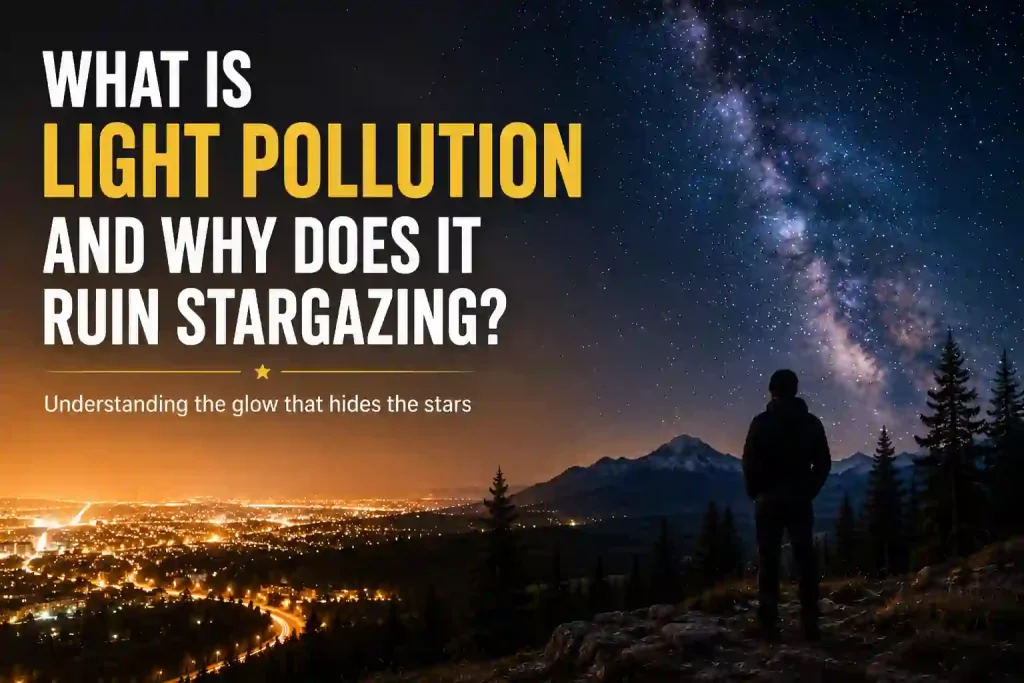
Light pollution is excess or misdirected artificial light at night, mostly from outdoor lighting, that brightens the sky and washes out what would otherwise be visible above it. According to DarkSky International, the organization that tracks and studies it, light pollution breaks down into four distinct types, and understanding which one is affecting you is the fastest way to understand why your own sky looks the way it does, and what, if anything, you can do about it.
The Four Types of Light Pollution
DarkSky International names four components that together make up what people casually call light pollution:
- Skyglow is the brightening of the night sky over inhabited areas, the orange or gray dome you see over a town or city from a distance. This is the type that matters most for stargazing, because it raises the sky's overall background brightness and buries faint objects in it.
- Glare is excessive brightness that causes visual discomfort, like an unshielded streetlight or floodlight shining directly at eye level. Glare does not just look unpleasant; it also actively interferes with your eyes' ability to dark-adapt.
- Light trespass is light falling where it is not intended or needed, such as a neighbor's security light spilling into your yard. This is often the most fixable type at a personal level, since it usually comes from one identifiable source.
- Clutter is bright, confusing, and excessive groupings of light sources, common in dense commercial areas, that make it hard to pick out anything specific against the visual noise.
What Light Pollution Actually Costs a Stargazer
Each type takes something specific away from what you can see:
- Skyglow raises the sky's baseline brightness, which is why faint, diffuse objects go first. The Milky Way's soft band is usually the earliest casualty, followed by dim deep-sky objects, then progressively brighter stars as skyglow worsens.
- Glare costs you dark adaptation directly. Even under a reasonably dark sky, a single unshielded light source at the wrong angle can keep your eyes from ever reaching their full sensitivity.
- Light trespass can ruin an otherwise good observing spot entirely, since a bright source in your direct field of view is far more disruptive than the same amount of light spread across the whole sky.
- Clutter mostly affects orientation. It does not necessarily dim the sky, but it makes it harder to pick out a specific planet or constellation against a visually busy background of competing lights near the horizon.
Skyglow is the one you cannot fix by walking to the other side of your yard. It is a regional effect, built up from every light source for miles around, which is why the honest fix for serious stargazing is usually not a better spot in the same town, but a genuinely darker location entirely.
Where This Fits on the Bortle Scale
If skyglow is the main villain, the Bortle scale is the tool that tells you exactly how much of it you are dealing with. It is a nine-level scale describing sky darkness, from inner-city skies where only the Moon and brightest planets are visible, down to truly pristine skies where the Milky Way casts a faint shadow. Our full guide to the Bortle scale explained walks through each level and how to figure out your own, which turns "my sky looks bad" from a vague impression into a specific, comparable number.
Can Anything Be Done About It?
At a personal level, yes, in a limited way. Light trespass and glare are the two types an individual can meaningfully address: shielding your own outdoor lights so they point down rather than outward, using warmer color temperatures, and only lighting what actually needs it are the standard dark-sky-friendly lighting practices DarkSky International promotes. These changes help your own property and, at scale, contribute to reducing skyglow regionally, but a single household's fix will not undo the accumulated skyglow from an entire city or region on its own. That takes broader adoption or municipal policy change, which is a longer, slower fight than anything one stargazer can solve alone.
Finding Darker Skies Near You
Since skyglow is the type most beginners actually run into, and it is not something you can shield your way out of, the more immediate fix for a specific night out is simply going somewhere darker. Our guide to finding a dark sky site near you covers how to locate genuinely darker skies within a reasonable drive, which makes a bigger difference to what you'll actually see than almost anything else, including gear. If you are new to stargazing altogether, our beginner's guide to starting stargazing is the place to start before planning a dark-sky trip.
Frequently Asked Questions
Does light pollution affect anything besides stargazing?
Yes. Light pollution has documented effects beyond the night sky, including disruption to nocturnal wildlife behavior and human circadian rhythms tied to nighttime light exposure. Stargazing is simply the effect most people notice first.
Can light pollution be reduced where I live?
Locally and partially, yes. Shielding outdoor lights so they point downward, using warmer light color temperatures, and only lighting what is actually needed are the standard dark-sky-friendly practices. A single property's changes will not undo an entire city's skyglow, but they reduce glare and light trespass immediately for that property and its neighbors.
Does weather make light pollution worse?
Cloud cover and haze can reflect and scatter artificial light back down, making skyglow appear worse on a hazy or partly cloudy night than on a clear one, even with the same amount of ground lighting.
Is light pollution the same everywhere in a city?
No. Light pollution varies significantly by exact location, even within the same city, based on nearby light sources, sky reflection, and line of sight. This is why the Bortle scale describes ranges rather than a single number per city.
Is there any type of light pollution I can't do anything about?
Skyglow is the hardest to address personally, since it accumulates from every light source across a wide region rather than any single fixable source near you. For serious stargazing, traveling to a darker location is usually more effective than trying to out-shield regional skyglow from where you already live.