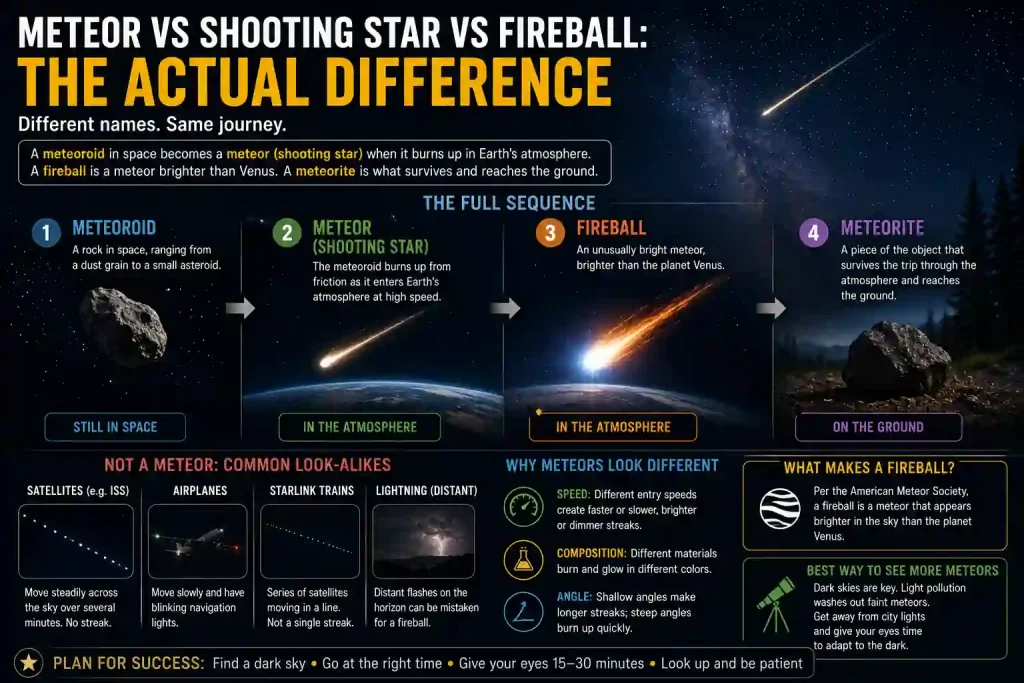
A meteor and a shooting star are the same thing: "meteor" is the scientific term, and "shooting star" is the everyday name for the same brief streak of light. According to NASA, the confusion mostly comes from the words used at different stages of one object's journey: a meteoroid in space becomes a meteor when it burns up in the atmosphere, and becomes a meteorite only if a piece survives to reach the ground. A fireball is simply an especially bright meteor, brighter than the planet Venus, according to the American Meteor Society. All four words describe points on the same sequence, not four different phenomena.
The Full Sequence: Meteoroid to Meteor to Meteorite
NASA lays out the sequence plainly, and it is worth learning as one continuous story rather than four separate vocabulary words:
| Term | What it is | Where it happens |
|---|---|---|
| Meteoroid | A rock in space, ranging from a dust grain to a small asteroid | Still in space |
| Meteor ("shooting star") | The meteoroid burning up from friction as it enters the atmosphere at high speed | In the atmosphere, visible as a streak |
| Fireball | An unusually bright meteor, brighter than Venus | In the atmosphere |
| Meteorite | A piece of the object that survives the trip through the atmosphere and reaches the ground | On the ground |
So the object you see as a "shooting star" is, at the moment you see it, correctly called a meteor. It only becomes a meteorite in the rare case that something survives the trip down and is later found on the ground, which is uncommon for the small, fast-burning particles responsible for most of what you see on an ordinary night.
What Makes Something a Fireball
Not every meteor gets the "fireball" label. Per the American Meteor Society, a fireball is specifically a meteor that appears brighter in the sky than the planet Venus, which is itself the brightest planet as seen from Earth. Most meteors you see on a normal night, including during a meteor shower, are considerably fainter than this threshold. A genuine fireball is a noticeably rarer, more dramatic event, sometimes bright enough to be seen briefly even against a partly lit sky, and sometimes accompanied by a visible trail that lingers for a few seconds after the streak itself fades.
What People Often Mistake for a Meteor
At a dark site, especially for a first-time observer, several other things get mistaken for meteors:
- Satellites, including the International Space Station, move steadily across the sky over several minutes as a small, non-blinking point of light, quite unlike a meteor's brief, fast streak that lasts a second or less.
- Airplanes move more slowly than a meteor and almost always show blinking navigation lights, which a meteor never does.
- Starlink satellite "trains" (recently launched batches moving in a visible line) can look unusual and unfamiliar the first time you see one, but they move at a steady satellite pace, not a meteor's instant streak, and appear as a series of points rather than a single flash.
- Lightning on the distant horizon can occasionally produce a brief flash that gets mistaken for a fireball from a distance, particularly if the storm itself is below the horizon and not directly visible.
The simplest test: a meteor is fast and brief, typically under a second or two for an ordinary one, while satellites and aircraft move steadily and take much longer to cross the sky.
Why Meteors Look Different From Each Other
Not every meteor looks the same, and the variation comes down to a few basic factors rather than anything mysterious. Speed matters: meteoroids hit the atmosphere at different velocities depending on their orbit relative to Earth's, which affects how fast and how bright the resulting streak appears. Composition matters too, since different materials burn and glow with slightly different colors as they vaporize. Angle of entry also plays a role: a meteoroid entering at a shallow angle tends to produce a longer, more gradual streak, while a steep entry burns up faster and more abruptly. None of this requires special equipment to notice, just enough nights spent watching to see the variation for yourself.
Getting the Conditions Right to See One
Meteors are visible any clear night, not just during a named shower, though named showers dramatically increase how many you will see per hour. What matters most is the same thing that matters for most naked-eye stargazing: a dark sky with minimal light pollution, since faint meteors simply disappear against a bright background sky the same way faint stars do. Our guide to finding a dark sky site near you and our guide to the best time of night to go stargazing both apply directly here. If you are planning a dedicated meteor-watching session, our stargazing checklist covers what to bring for a longer session spent lying back and watching, and if you are completely new to any of this, our beginner's guide to starting stargazing is the place to start.
Frequently Asked Questions
Is a shooting star actually a star?
No. Despite the name, a shooting star is not a star at all. It is a small piece of rock or dust (a meteoroid) burning up from friction as it passes through Earth's atmosphere at high speed, which astronomers call a meteor.
How rare is a fireball compared to a regular meteor?
Fireballs are meaningfully rarer than ordinary meteors, since by the American Meteor Society's definition they must appear brighter than Venus, a threshold most meteors do not reach. Exactly how often you will see one depends heavily on how much time you spend watching and how dark your sky is.
If I see a meteor, can I go find the meteorite afterward?
Almost never, for practical purposes. The vast majority of meteors are caused by particles too small to survive the trip through the atmosphere; they burn up completely and there is nothing left to find. Confirmed meteorite recoveries typically follow well-documented, unusually bright fireball events, tracked and investigated by researchers, not an ordinary meteor sighting.
Do meteors make sound?
Very bright fireballs are occasionally reported with accompanying sound, but this is uncommon and tied to unusually large or bright events, not something to expect from an ordinary meteor.
What's the difference between a meteor shower and a random meteor?
A random meteor can occur on any clear night from scattered debris. A meteor shower happens when Earth passes through a denser trail of debris left by a specific comet or asteroid, producing a much higher rate of meteors, often appearing to radiate from one point in the sky, over a predictable time of year.